Question 1 of 40 Signals and pavement markings
You reach an intersection where the traffic lights are not working at all. In general, what should you do?
A A. Go through at normal speedB B. Treat it as an all-way stopC C. Treat it as a yield for you onlyD D. Turn around and find another road
Question 2 of 40 Speed and following distance
Why do many states raise fines for speeding in a work zone?
A A. To pay for the cost of road repairsB B. Because work zones have more policeC C. Workers are close to traffic and can be hurtD D. Because cars use more fuel in work zones
Question 3 of 40 Right of way
A green light lets you go straight, but a car is still turning left in front of you from the last light. What should you do?
A A. Go, since your light is green nowB B. Let it finish its turn before you goC C. Honk so it hurries out of the wayD D. Drive around the back of it
Question 4 of 40 Sharing the road (Washington)
The Washington guide gives a stopping distance for a loaded truck at 55 mph. About how far is it?
A A. 150 feetB B. 250 feetC C. 450 feetD D. 650 feet
Question 5 of 40 Alcohol, drugs and penalties (Washington)
What blood alcohol level brings DUI penalties for a Washington driver under 21?
A A. 0.02% or moreB B. 0.04% or moreC C. 0.06% or moreD D. 0.08% or more
Question 6 of 40 Speed and following distance
Why should you not use cruise control on wet or icy roads?
A A. It uses too much fuel in the rainB B. It turns off your lights and wipersC C. You may lose control if the tires slipD D. It makes the brakes lock up at once
Question 7 of 40 Road signs (Washington)
Washington has automated traffic safety cameras. Which of these can they record?
A A. Not using a turn signalB B. Speeding in a school zoneC C. Driving in the left laneD D. An expired plate tab
Question 8 of 40 Parking and stopping
How should you start to parallel park?
A A. Pull up beside the car in front of the spaceB B. Back straight into the space from behind itC C. Drive in nose first and then straighten outD D. Stop behind the space and wait for a gap
Question 9 of 40 Safe driving and hazards (Washington)
Washington law says your headlights must be on starting how long after sunset?
A A. A quarter hourB B. One hourC C. Two hoursD D. A half hour
Question 10 of 40 Parking and stopping
How should you pull out of a parallel parking space?
A A. Pull out quickly before more cars comeB B. Honk to warn traffic, then pull outC C. Back out into the lane, then go forwardD D. Signal, check your blind spot, and yield
Question 11 of 40 Speed and following distance
You are driving in a neighborhood with homes and parks. What should you do?
A A. Drive at the speed you would on a highwayB B. Use your horn often to warn childrenC C. Keep your speed low and watch for childrenD D. Stay in the middle of the road
Question 12 of 40 Parking and stopping
Before you open your door on the street side, what should you do?
A A. Open it quickly to get out of the wayB B. Honk your horn to warn people firstC C. Check for cars and bikes behind youD D. Turn on your hazard lights and open it
Question 13 of 40 Road signs
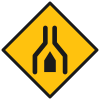
What should you expect after this sign?
A A. Oncoming traffic with no median between youB B. A median that will split the two directionsC C. A road that becomes one-wayD D. Two lanes going your way merging into one
Question 14 of 40 Sharing the road
What are the "no zones" around a large truck?
A A. Lanes where trucks are not allowed to driveB B. Areas where trucks may not park overnightC C. Places where cars may not pass a truckD D. Blind spots where the driver cannot see you
Question 15 of 40 Alcohol, drugs and penalties
What can happen if you get many traffic tickets in a short time?
A A. You get a safe-driving rewardB B. Your license lasts longerC C. Your license can be suspendedD D. Your insurance goes down
Question 16 of 40 Signals and pavement markings
A center lane is marked with a solid yellow line and a broken yellow line on each side. What is it for?
A A. Passing slow traffic on a two-lane roadB B. Buses, taxis and carpools onlyC C. Left turns by traffic from both directionsD D. Parking for short stops and deliveries
Question 17 of 40 Safe driving and hazards
You need to make a phone call while driving. What is the safest choice?
A A. Pull over to a safe place firstB B. Call while stopped at a lightC C. Hold the phone low, out of sightD D. Call only on short trips
Question 18 of 40 Right of way
An emergency vehicle without its siren or lights on is behind you. Must you pull over?
A A. Yes, always pull over for oneB B. No, treat it like other trafficC C. Yes, but only when on a highwayD D. Yes, and stop until it turns
Question 19 of 40 Licensing and insurance (Washington)
May a Washington intermediate license holder talk on a hands-free phone while driving?
A A. No, only to report an emergencyB B. Yes, if the phone is mountedC C. Yes, but only on speakerD D. Yes, after 6 months of driving
Question 20 of 40 Speed and following distance
You are driving on snow or ice. What should you do?
A A. Go much slower and leave a lot more spaceB B. Drive at your usual speed but brake earlyC C. Brake hard now and then to test the roadD D. Follow close behind the car ahead
Question 21 of 40 Signals and pavement markings
What does a flashing yellow arrow pointing left mean?
A A. You may turn left after yieldingB B. You have a protected left turnC C. You must stop and wait for a green lightD D. Left turns are banned at this light
Question 22 of 40 Safe driving and hazards
When is a road often most slippery during rain?
A A. After it has rained for hoursB B. At night, when the air is coldC C. Right after the rain stopsD D. In the first few minutes of rain
Question 23 of 40 Turning, passing and lanes
When might you need a three-point turn?
A A. To park on a hill with a curbB B. To pass a slow car on a narrow roadC C. To enter a highway from a rampD D. To turn around on a narrow street
Question 24 of 40 Right of way
You are at a crosswalk and a child runs out after a ball. What should you do?
A A. Swerve around the child and keep goingB B. Honk and keep going at the same speedC C. Stop and expect more children to followD D. Speed up to pass before more come
Question 25 of 40 Road signs
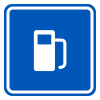
What does this blue sign beside the highway tell you?
A A. Fuel is available at or near the next exitB B. A fuel tanker may be on the roadC C. You must stop for a vehicle checkD D. The highway has a rest area with no services
Question 26 of 40 Parking and stopping
Your car is parked on a downhill slope beside a curb. How should the front wheels point?
A A. Away from the curbB B. Straight aheadC C. Toward the middle of the roadD D. Toward the curb
Question 27 of 40 Road signs
A sign says "DEAD END" or "NO OUTLET". What does it tell you?
A A. The road is closed for repairsB B. You must turn around right nowC C. The road is for local buses and taxis onlyD D. The road does not connect to another road
Question 28 of 40 Sharing the road
A car is stopped ahead with people getting out of it near a crosswalk. What should you do?
A A. Speed up to pass it quicklyB B. Honk as you pass the carC C. Slow down and watch for peopleD D. Drive in the oncoming lane
Question 29 of 40 Emergencies and equipment (Washington)
A Washington child age 4 or older rides in a car or booster seat until the belt fits. What height is the guide line for that?
A A. 4'9"B B. 4'0"C C. 4'5"D D. 5'2"
Question 30 of 40 Right of way (Washington)
A Washington school bus ahead stops with red lights flashing. You are in a center turn lane. What must you do?
A A. Use the turn lane to pass the busB B. Turn left fast before kids get offC C. Keep going if you are turning awayD D. Stop, just like the other lanes
Question 31 of 40 Signals and pavement markings
An officer at an intersection waves you on through a red light. What should you do?
A A. Wait for the light to turn green firstB B. Turn right instead of going straightC C. Stop and ask the officer why you should goD D. Follow the officer and go through with care
Question 32 of 40 Road signs (Washington)
In thick fog in Washington, you drive a bit under the posted limit. Can you still get a speeding ticket?
A A. No, the posted limit is all that countsB B. Only if you go 10 mph over the limitC C. Only where a minimum speed is postedD D. Yes, if you are too fast for the fog
Question 33 of 40 Road signs
A crossing has only this sign, with no lights or gates. What should you do?
A A. Cross at normal speed, since there is no signalB B. Stop only if a gate starts to come downC C. Sound your horn and cross as fast as you canD D. Look both ways and stop if a train is near
Question 34 of 40 Speed and following distance (Washington)
Washington roundabouts are built for what range of speeds?
A A. 5 to 10 mphB B. 15 to 25 mphC C. 25 to 35 mphD D. 35 to 45 mph
Question 35 of 40 Parking and stopping
Why is it unsafe to stop or park on railroad tracks?
A A. A train could hit your carB B. It can damage your tiresC C. It is only unsafe at nightD D. It blocks people walking
Question 36 of 40 Safe driving and hazards
On a long, dull highway drive, you start to feel drowsy and stare blankly ahead. What should you do?
A A. Drive faster so you finish soonerB B. Look only at the road right aheadC C. Take a break and move your eyes oftenD D. Turn up the heat and the radio
Question 37 of 40 Road signs
A sign says "REDUCED SPEED AHEAD". What should you do?
A A. Speed up before the limit changesB B. Get ready to slow down to a lower limitC C. Stop at the next sign and waitD D. Move over to the left lane at once
Question 38 of 40 Turning, passing and lanes
Where should you slow down when leaving a highway?
A A. In the exit lane, after leaving the main lanesB B. In the main lanes, before you reach the exitC C. On the shoulder, before the exit rampD D. In the left lane, so others can pass
Question 39 of 40 Road signs
A sign and a police officer at an intersection give you different orders. Whom do you obey?
A A. The signB B. Whichever is closer to youC C. The police officerD D. Whichever is more cautious
Question 40 of 40 Right of way (Washington)
At a Washington intersection with no signs, you are on a secondary road about to enter a state highway. Who must yield?
A A. Highway traffic must yield to youB B. You must yield to highway trafficC C. Whoever has the larger vehicleD D. Whoever is driving faster
Answer each question to see the explanation. Keyboard: A–D or 1–4 to answer, N next, P previous.