Question 1 of 40 Right of way
At a four-way stop, who should go first?
A A. The driver in the biggest vehicleB B. The driver going the fastestC C. The driver turning leftD D. The driver who stopped first
Question 2 of 40 Turning, passing and lanes
When should you signal a turn?
A A. Only as you start to turn the wheelB B. Only if a car is right behind youC C. Early, before you slow down or turnD D. Only when other cars are close by
Question 3 of 40 Speed and following distance
School zone lights are flashing and children are near. What should you do?
A A. Keep your normal speed through the zoneB B. Speed up so you clear the zone soonerC C. Stop and wait for the lights to stop flashingD D. Slow to the school limit and watch for children
Question 4 of 40 Sharing the road (Washington)
In Washington, slow farm vehicles show an orange triangle emblem. What top speed are they built for?
A A. 15 mph or lessB B. 25 mph or lessC C. 35 mph or lessD D. 45 mph or less
Question 5 of 40 Licensing and insurance (Washington)
What is the least Washington liability insurance must pay for injury or death of one person in a crash?
A A. $10,000B B. $15,000C C. $25,000D D. $50,000
Question 6 of 40 Turning, passing and lanes
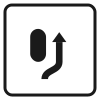
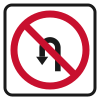
Where is a U-turn most likely to be unsafe or not allowed?
A A. On a quiet street with a clear view both waysB B. At a light that has a U-turn arrowC C. Near a curve or hill where others cannot see youD D. On a wide road with no traffic in sight
Question 7 of 40 Road signs (Washington)
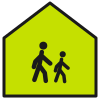
In Washington, what does a bright yellow-green warning sign tell you to watch for?
A A. Road work and crews aheadB B. Parks and places to campC C. Schools, walkers, or bike ridersD D. Gas, food, and rest stops
Question 8 of 40 Parking and stopping
A police car signals you to pull over. What should you do?
A A. Stop in your lane right awayB B. Get out and walk back to the officerC C. Pull to the right and stay in the carD D. Keep going to the next exit first
Question 9 of 40 Safe driving and hazards (Washington)
Where in Washington may you drive a car on an ocean beach?
A A. Only in Grays Harbor and Pacific countiesB B. On any beach the state ownsC C. Only in King and Pierce countiesD D. Nowhere; beach driving is banned
Question 10 of 40 Alcohol, drugs and penalties
Marijuana is legal for adults in some states. Is it legal to drive while impaired by it?
A A. Yes, in states where it is legalB B. Yes, if you have a medical cardC C. Yes, if you used only a small amountD D. No, impaired driving is illegal everywhere
Question 11 of 40 Turning, passing and lanes
In what order should you change lanes?
A A. Move over first, then signal and checkB B. Check your mirrors, move over, then signalC C. Signal, check mirrors and blind spot, then moveD D. Signal and move over at the same time
Question 12 of 40 Alcohol, drugs and penalties
Which drinks hold about the same amount of alcohol?
A A. A 12 oz beer, a 5 oz glass of wine, and a 1.5 oz shotB B. A 12 oz beer, a 12 oz glass of wine, and a 5 oz shotC C. A 5 oz beer, a 12 oz glass of wine, and a 1.5 oz shotD D. A 12 oz beer and a 12 oz glass of wine
Question 13 of 40 Road signs
What does this sign tell you to do?
A A. Turn right at the next streetB B. Stay in the right lane until the road endsC C. Pass to the right of the island aheadD D. Move right to let faster cars pass you
Question 14 of 40 Safe driving and hazards
What is the main danger of driving when angry or upset?
A A. You may drive too slowlyB B. Your car may overheatC C. You may use more fuelD D. You may take more risks
Question 15 of 40 Safe driving and hazards
You feel very sleepy while driving. What should you do?
A A. Open the window and keep goingB B. Stop in a safe place and restC C. Turn up the radioD D. Drive faster to get home sooner
Question 16 of 40 Speed and following distance
How can you check your following distance?
A A. Count the car lengths between you and itB B. Count the seconds to reach a point it passedC C. Watch how often its brake lights come onD D. Check your speed against the posted limit
Question 17 of 40 Safe driving and hazards
Which of these is a cognitive distraction?
A A. Looking at a billboardB B. Daydreaming about your plansC C. Tuning the radio by handD D. Reaching for a drink in a cup holder
Question 18 of 40 Speed and following distance
You are going too fast as you enter a curve. What is the best thing to do?
A A. Brake hard in the middle of the curveB B. Speed up so you get through it fasterC C. Turn the wheel sharply toward the insideD D. Ease off the gas and steer smoothly through it
Question 19 of 40 Safe driving and hazards (Washington)
On a long trip, how often does the Washington guide suggest you plan to stop?
A A. About every 50 miles or 1 hourB B. About every 200 miles or 4 hoursC C. About every 300 miles or 5 hoursD D. About every 100 miles or 2 hours
Question 20 of 40 Speed and following distance
Compared to dry pavement, stopping on ice takes:
A A. Much longerB B. About the same distanceC C. Less distanceD D. Only a little longer
Question 21 of 40 Road signs
An Interstate route has three digits, and the first digit is even. What does that usually mean?
A A. It runs only east and west across the countryB B. It is a toll road with no free lanesC C. It is closed to trucks in winterD D. It loops around a city or links two Interstates
Question 22 of 40 Safe driving and hazards
Why should you keep your windshield clean?
A A. Dirt and glare make it harder to seeB B. It helps the car go a little fasterC C. It helps you save some fuelD D. It only makes the car look nice
Question 23 of 40 Turning, passing and lanes
In a roundabout with two lanes, how do you choose your lane?
A A. Inside the roundabout, as you go roundB B. Always use the inside lane to be safeC C. Always use the outside lane to be safeD D. Before you enter, based on your exit
Question 24 of 40 Speed and following distance
Why does the risk of hydroplaning go up as you drive faster?
A A. Your brakes get too hot to work wellB B. Your engine starts to use more fuelC C. Your headlights get dimmer at speedD D. Your tires cannot push water away fast enough
Question 25 of 40 Road signs
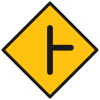
What should you expect after you pass this sign?
A A. Cars may enter from a road on the rightB B. Your road ends and you must turn rightC C. The right lane is closed aheadD D. The road bends sharply to the right
Question 26 of 40 Parking and stopping
How should you back out of an angled parking space?
A A. Quickly, before other cars comeB B. Using only your side mirrorsC C. Slowly, looking all around youD D. With your horn held down
Question 27 of 40 Road signs
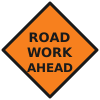
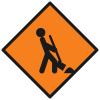
What does this orange sign tell you?
A A. The road ahead is closed, so turn aroundB B. There is road work ahead, so slow downC C. A detour begins right hereD D. A flagger has stopped all traffic ahead
Question 28 of 40 Emergencies and equipment
How should you brake hard in a car with anti-lock brakes?
A A. Pump the brakes quickly and hardB B. Press lightly, then let go fastC C. Pull the parking brake as hard as you canD D. Press firmly and hold steady pressure
Question 29 of 40 Speed and following distance (Washington)
A Washington work zone has a lower posted speed, but you see no workers. What should you do?
A A. Still slow down and obey the work zone signsB B. Drive at the normal posted speed limitC C. Keep up with the speed of other trafficD D. Slow down only if you see workers
Question 30 of 40 Turning, passing and lanes (Washington)
In Washington, when may you make a U-turn?
A A. In general, unless a sign forbids itB B. Only at a light with a green arrowC C. Only in a business districtD D. Never on a city street
Question 31 of 40 Right of way
Which statement about the right-of-way is true?
A A. No driver should insist on taking itB B. The faster car always has the right-of-wayC C. You can take it if you honk firstD D. It always goes to the larger vehicle
Question 32 of 40 Speed and following distance (Washington)
What is the speed limit on a Washington ocean beach where driving is allowed?
A A. 15 mphB B. 25 mphC C. 35 mphD D. 45 mph
Question 33 of 40 Road signs
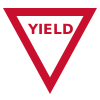
You reach this sign as a car with the right-of-way is coming. What should you do?
A A. Keep your speed if you got to the sign firstB B. Slow down or stop and let that car go firstC C. Flash your lights so the other driver waitsD D. Speed up to get through before the car arrives
Question 34 of 40 Alcohol, drugs and penalties (Washington)
What happens to the fine in Washington if you pass a stopped school bus?
A A. It is doubledB B. It is cut in halfC C. It is waived the first timeD D. It stays the usual amount
Question 35 of 40 Parking and stopping
Traffic is backed up and you are about to cross railroad tracks. What should you do?
A A. Stop on the tracks until traffic moves onB B. Drive onto the tracks and wait thereC C. Back up into the car behind youD D. Wait until there is room past the tracks
Question 36 of 40 Safe driving and hazards
When should you use your horn?
A A. To show you are angryB B. To greet friendsC C. To make traffic move fasterD D. To warn others of danger
Question 37 of 40 Road signs
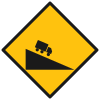
What should you do while going down the grade this sign warns about?
A A. Shift to neutral and coast to save fuelB B. Press the brake pedal hard all the way downC C. Speed up to reach the bottom of the hill soonerD D. Shift to a lower gear and keep your speed down
Question 38 of 40 Turning, passing and lanes
When joining a highway, what should you look for?
A A. The car with the loudest hornB B. A place to stop and wait on the rampC C. A gap in traffic to merge intoD D. An empty left lane
Question 39 of 40 Road signs
This orange sign shows a person with a shovel. What does it warn you about?
A A. People crossing at a crosswalkB B. People working on or near the roadC C. Hikers walking on a nearby trailD D. Children crossing near a school
Question 40 of 40 Alcohol, drugs and penalties (Washington)
For a Washington driver 21 or older, what level of active THC in the blood (ng per mL) counts as a DUI?
A A. 1 ngB B. 5 ngC C. 10 ngD D. 20 ng
Answer each question to see the explanation. Keyboard: A–D or 1–4 to answer, N next, P previous.