Road-sign questions 20 questions · Pass mark: 16 of 20 (80%) · No time limit
Time taken 0:00
Finish test
Questions
1 2 3 4 5 6 7 8 9 10 11 12 13 14 15 16 17 18 19 20
Question 1 of 20 Signs and markings
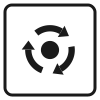
You are driving a small car into a roundabout at this sign. The central island has a low kerb. May you drive over it to save time?
A A. No, keep your wheels off the central islandB B. Yes, if no other cars are in the roundaboutC C. Yes, if you are turning right at the exitD D. Yes, if the island is flat enough to cross
Question 2 of 20 Signs and markings
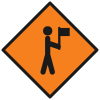
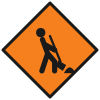
You see this sign ahead of a work site. What should you expect?
A A. A school crossing where children may crossB B. A railway crossing where a worker may wave you acrossC C. A worker controlling traffic, so be ready to stopD D. A worker digging, so move to the other lane
Question 3 of 20 Signs and markings
You are stopped at this sign. No train is coming, but traffic on the far side of the tracks has stopped. What should you do?
A A. Wait behind the line until there is room to clear the tracksB B. Move onto the tracks so that you are ready when traffic movesC C. Edge forward and wait with your front wheels past the railsD D. Cross and stop between the tracks while the queue moves
Question 4 of 20 Signs and markings
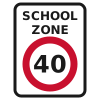
In the Northern Territory you pass this sign on a school day, during the times shown on it. No children are in sight. What must you do?
A A. Slow to the zone limit only when you can see childrenB B. Keep to the zone limit only near the school gate itselfC C. Drive at the normal limit, as no one is near the roadD D. Keep to the zone limit until the end of the zone
Question 5 of 20 Signs and markings
In Australia, you stop briefly at this sign to drop a parcel at a shop door. How far may you go from your car?
A A. 3 metresB B. 6 metresC C. 12 metresD D. 25 metres
Question 6 of 20 Signs and markings
You pass this sign on a road through open country. What is it warning you about?
A A. A road for trucks joins from the sideB B. Road works with a flag person are aheadC C. A railway level crossing is aheadD D. A one-lane bridge is just ahead
Question 7 of 20 Signs and markings
You are on a gravel road with corrugations when you see this sign. What is the safest way to drive the bends ahead?
A A. Keep up your speed so the wheels skip over the bumpsB B. Drive near the centre of the road to get a better viewC C. Brake hard in the middle of each bend to stay in controlD D. Slow down so the tyres keep their grip in each curve
Question 8 of 20 Signs and markings
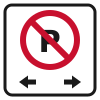
In Australia, when may you stop your car at the kerb in an area covered by this sign?
A A. When you drop off a passenger quicklyB B. When you unload goods for a short timeC C. When you stay within 3 metres of the carD D. Only in a medical or other emergency
Question 9 of 20 Signs and markings
This sign is fixed to the end of a barrier that sticks out into the left side of your lane. How should you go past it?
A A. Go to the left of it, between it and the kerbB B. Go to the right of it, the way the chevrons pointC C. Go either side, whichever has less trafficD D. Stop beside it and then pick a side
Question 10 of 20 Signs and markings
You see this sign on the front of a traffic island that splits the road. Which way may you pass it?
A A. On either the left or the right side of itB B. Only on the left side of the islandC C. Only on the right side of the islandD D. Only after you stop to check both sides
Question 11 of 20 Signs and markings
You pass this sign near a busy shopping strip. What should you expect?
A A. A school zone with a lower speed limit aheadB B. People could be walking across the road aheadC C. A bus stop where you must stop for busesD D. A cycle lane where riders cross the road ahead
Question 12 of 20 Signs and markings
You reach this sign at a level crossing that has no lights, gates or booms. What should you do?
A A. Cross at normal speed, as a train would sound its hornB B. Cross quickly so that you spend less time on the trackC C. Stop only if you can already see a train close to youD D. Slow down, then look and listen for trains both ways
Question 13 of 20 Signs and markings
You see this sign as you come into a town. What is it warning you about?
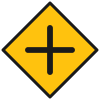
A A. A crossroads with no signs is coming upB B. A one-way street is coming upC C. A roundabout is coming up, so slow downD D. A car park entrance is coming up
Question 14 of 20 Signs and markings
Your quiet street meets a main road at this sign. A car is coming along the main road towards you. What must you do?
A A. Drive out first, as the car on the main road must slow down for youB B. Sound your horn to warn the driver, then pull out in frontC C. Speed up so that you reach the main road ahead of the carD D. Slow down, and stop if needed, to let the car pass
Question 15 of 20 Signs and markings
You see this sign as a truck comes toward you on a two-lane road. What should you do?
A A. Slow down and keep left, as the road gets narrowerB B. Speed up so you pass the narrow part before the truckC C. Move toward the centre so the truck keeps to its edgeD D. Flash your lights so the truck stops for you
Question 16 of 20 Signs and markings
You are driving on a road with two lanes going your way when you pass this sign. What does it warn you about?
A A. A side road joins from the rightB B. Two lanes are about to become one laneC C. The road ahead splits into two roadsD D. A sharp bend to the left with a steep drop
Question 17 of 20 Signs and markings
You pass this sign and plan to turn right at a two-lane roundabout. Which lane and signal should you use on the way in?
A A. The left lane, signalling rightB B. The right lane, signalling rightC C. The right lane, with no signalD D. Either lane, signalling left
Question 18 of 20 Signs and markings
You are waiting at traffic lights with this sign on the pole. When the light turns green there is a long gap in oncoming cars. May you turn around?
A A. Yes, as long as the gap is big enoughB B. Yes, if you give way to people on footC C. No, U-turns are not allowed at this placeD D. Yes, but only from the right-hand lane
Question 19 of 20 Signs and markings
You are in the right lane at traffic lights showing this sign, with no times on it. Your home is to the right. What should you do?
A A. Turn right if no oncoming cars are close to youB B. Turn right as soon as the light turns greenC C. Go another way, as you must not turn right hereD D. Turn right if you signal for long enough first
Question 20 of 20 Signs and markings
After this sign, you turn right at the roundabout and signal right as you go round. What should you do just before you leave it?
A A. Keep the right signal on until you exitB B. Turn off all signals and just drive outC C. Switch on your hazard lights as you exitD D. Switch to a left signal, where you can
Answer each question to see the explanation. Keyboard: A–D or 1–4 to answer, N next, P previous.
View
Restart
Turn on JavaScript to answer questions, see explanations and get your score.
Australian road signs and the Australian Road Rules as applied in the NT, set out in the NT Road Users' Handbook ('information about the rules of the road and basic driving skills' and 'the Australian Road Rules which are used in each state and territory of Australia'). 16 correct (80%) is our practice mark, not an official pass mark.
Link to this quiz Driving instructors, schools and learner forums are welcome to link to this free road-sign quiz.
Australia road signs and what they mean Our own simplified drawings of the signs learners meet most. The full list, with meanings, is in the Australia sign library ; the official reference is the NT Road Users' Handbook .
Regulatory signs Stop
Stop completely at the stop line, then give way to all traffic before moving on.
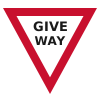
Give way
Slow down and stop if needed to let other traffic go first.
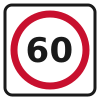
Speed limit
The maximum legal speed until another limit is shown.
School zone
A lower speed limit applies during the school times shown on the sign.
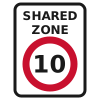
Shared zone
Pedestrians and vehicles share this space; give way to pedestrians and keep to the low limit shown.
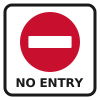
No entry
You must not drive into this road from this direction.
Keep left
Keep to the left of the island or divider ahead.
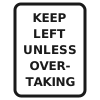
Keep left unless overtaking
Stay in the left lane except when overtaking; the sign applies on roads where it is posted, which each state sets by speed limit.
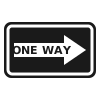
One way
Traffic travels only in the direction of the arrow.
No left turn
You must not turn left here.
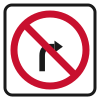
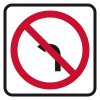
No right turn
You must not turn right here.
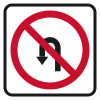
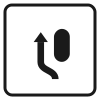
No U-turn
You must not make a U-turn here.
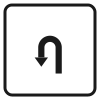
U-turn permitted
You may make a U-turn here, giving way to all other vehicles and pedestrians.
Roundabout
You are entering a roundabout; give way to vehicles already in it and travel clockwise.
No parking
You may stop for up to 2 minutes to drop off or pick up passengers or goods, but must stay within 3 m of the vehicle.
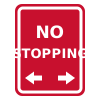
No stopping
You must not stop at any point in the direction of the arrows unless forced to by traffic or an emergency.
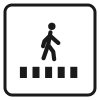
Pedestrian crossing
Marks a pedestrian (zebra) crossing; give way to anyone on or entering it.
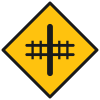
Railway level crossing
Marks the level crossing; give way to trains and stop if one is approaching.
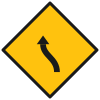
Warning signs Curve to the left
The road bends left ahead; slow to a safe speed before the curve.
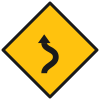
Winding road
Several bends lie ahead; keep your speed down.
Crossroad ahead
A road crosses ahead; watch for vehicles from both sides.
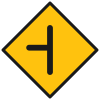
Side road on the left
A side road joins from the left ahead.
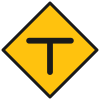
T-junction
The road ends at a crossing road ahead; you will need to turn left or right.
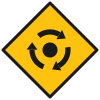
Roundabout ahead
A roundabout is coming up; slow down and prepare to give way.
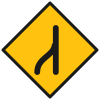
Lanes merge
Two lanes become one ahead; merge smoothly and give way as required.
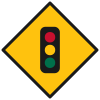
Traffic signals ahead
Traffic lights are ahead; be ready to stop.
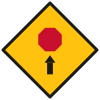
Stop sign ahead
A stop sign is ahead; slow down and prepare to stop.
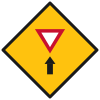
Give way sign ahead
A give way sign is ahead; slow down and be ready to give way.
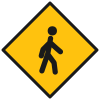
Pedestrians ahead
People may be walking on or crossing the road ahead.
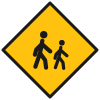
Children crossing ahead
Children may be crossing ahead, often near a school; slow down.
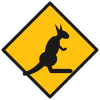
Kangaroos / wildlife
Kangaroos or other wildlife may be on the road; slow down, especially at dawn and dusk.
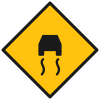
Slippery when wet
The road may be slippery when wet; slow down.
Railway crossing ahead
A railway level crossing is ahead; slow down and look for trains.
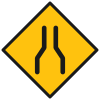
Road narrows
The road becomes narrower ahead; take care with oncoming traffic.
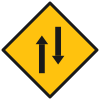
Two-way traffic ahead
Oncoming traffic shares the road ahead.
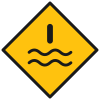
Road subject to flooding
Water may cover the road here; never drive into floodwater.
Hazard signs Hazard marker (pass on the left)
An obstruction is ahead and all traffic must go around it in the direction the chevrons point, here to the left.
Hazard marker (pass on the right)
An obstruction is ahead and all traffic must go around it in the direction the chevrons point, here to the right.
Hazard marker (pass either side)
Marks the nose of an island or obstruction that traffic may pass on either side.
Next Advertisement