Question 1 of 30 Road rules
You hear a siren behind you as you approach an intersection on a busy road. What should you do as you make way for the emergency vehicle?
A A. Stop at once in the middle of the intersectionB B. Brake hard right in front of the vehicleC C. Stop inside the intersection so it can go around youD D. Give way, but keep the intersection clear
Question 2 of 30 Learner and P-plate rules
In the Northern Territory, four drivers have each held an NT P licence for two years and are now in its last six weeks. Who can get a free 10-year open car licence?
A A. A driver with one speeding offence last yearB B. A driver with one red light offence on recordC C. A driver who had a short suspension for pointsD D. A driver with no traffic offences or suspensions
Question 3 of 30 Hazards and sharing the road
You are first to arrive at a crash. A driver is awake but stuck in the car, and there is no sign of fire. What should you do?
A A. Pull them out in case the car movesB B. Leave them in the car and call 000C C. Drag them clear onto the roadD D. Walk them to your own car
Question 4 of 30 Road rules
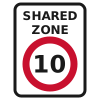
You turn into a shopping street where people on foot, cyclists and cars all share the road space. What speed limit do these zones often have?
A A. 10 km/hB B. 20 km/hC C. 25 km/hD D. 35 km/h
Question 5 of 30 Hazards and sharing the road
Two cyclists are riding side by side ahead of you on a two-lane road. How should you overtake them?
A A. Pass them as you would pass a car, with careB B. Sound your horn so they ride in single fileC C. Squeeze past while keeping in your own laneD D. Pass between the two riders if there is room
Question 6 of 30 Signs and markings
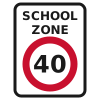
In the Northern Territory you pass this sign on a weekday in the school holidays, within the hours shown on it. What limit applies?
A A. The zone limit, since the hours on the sign applyB B. The zone limit, but only on the side by the schoolC C. The road's normal limit, as the zone hours are overD D. Half the normal limit, as children may still be about
Question 7 of 30 Signs and markings
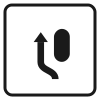
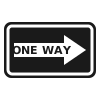
This sign is on a traffic island in the middle of the road ahead of you. How must you pass the island?
A A. Pass on whichever side is clearB B. Pass on the right side of itC C. Stop, then pass when there is a gapD D. Pass on the left side of it
Question 8 of 30 Hazards and sharing the road
You reach a flooded causeway with 'road closed' signs in place, but a local says the water is shallow. What should you do?
A A. Cross slowly if it looks shallowB B. Cross quickly before it risesC C. Follow the local's car through at the same speedD D. Do not cross while the road is closed
Question 9 of 30 Signs and markings
You see this sign on a pole in front of a concrete barrier. How must you drive past?
A A. Pass on the right side, against the arrowsB B. Pass on the left side, where the arrows pointC C. Pass on either side, whichever is clearerD D. Stop, as the road is closed beyond the sign
Question 10 of 30 Road rules
It is after sunset and you are driving on a town street with bright street lights. Must your headlights be on?
A A. No, not on streets where the lights are working wellB B. Only on roads that are outside townsC C. Only if it is also raining or foggy outsideD D. Yes, they must be on from sunset to sunrise
Question 11 of 30 Alcohol, drugs and penalties
In the Northern Territory, a driver tests positive on a first roadside saliva test for drugs. What will police require next?
A A. A breath test for alcohol and nothing elseB B. An eye test at the nearest MVR officeC C. A second saliva test, there at the roadsideD D. A written promise not to drive that day
Question 12 of 30 Road rules
You are on a country road with a 100 km/h limit and come up behind a cyclist. What is the least gap you must leave when you pass?
A A. 1 metreB B. 1.5 metresC C. 1.75 metresD D. 2.5 metres
Question 13 of 30 Hazards and sharing the road
You are overtaking a road train on an open highway. When is it safe to move back into the left lane?
A A. As soon as your rear bumper is past its front bumperB B. When the truck driver sounds the horn at youC C. When you can see both its headlights in your mirrorD D. Once you have slowed down to let it drop back
Question 14 of 30 Signs and markings
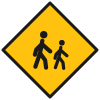
You see this sign at 8.15 am on a school day. Children are walking along the footpath. What should you do?
A A. Keep your speed, as children must wait for a gapB B. Sound your horn so the children stay on the pathC C. Speed up to get past before the children reach the roadD D. Drive slowly and be ready to stop for children
Question 15 of 30 Road rules
The lane you are driving in is ending, and you must cross a lane line to join the lane beside you. Who must give way?
A A. Traffic in that lane must let you in firstB B. The car that is further ahead goes firstC C. The faster of the two vehicles goes firstD D. You must give way to traffic in that lane
Question 16 of 30 Safe driving
You are stopped in an intersection, waiting for a gap to turn right across oncoming traffic. Why should your front wheels stay straight?
A A. So you can turn faster once a gap appearsB B. So drivers behind know you are going straightC C. So the power steering does not strain while you waitD D. So a hit from behind won't push you into oncoming cars
Question 17 of 30 Signs and markings
You turn into a narrow street past this sign. A group of people are walking down the middle of the road ahead. What must you do?
A A. Give way to the people walking in the streetB B. Sound your horn so that they move off to the side of the roadC C. Keep going, as people on foot must give way to cars hereD D. Drive around them quickly while the other side is clear
Question 18 of 30 Signs and markings
A warning sign at the top of a long hill shows a steep descent ahead. How should you control your speed going down?
A A. Coast down in neutral to save fuelB B. Keep the brake pressed hard the whole wayC C. Change up to a higher gear for more gripD D. Slow down and change to a lower gear
Question 19 of 30 Road rules
You are driving in the left lane in a 60 km/h zone. A bus at a stop ahead shows a 'give way to buses' sign and its right indicator is flashing. What must you do?
A A. Slow down or stop and let the bus pull outB B. Keep going, as the bus must wait for a gapC C. Change lanes and speed past the bus quicklyD D. Sound your horn to warn the bus to stay put
Question 20 of 30 Road rules
In the Northern Territory, it is a school day and you pass a school zone sign during the times it shows. What is the most you may drive?
A A. 20 km/hB B. 25 km/hC C. 35 km/hD D. 40 km/h
Question 21 of 30 Safe driving
You are driving through a busy shopping strip. What is the best way to use your eyes?
A A. Fix your gaze on the road just in front of your bonnetB B. Watch the car ahead and check your mirrors only when you plan to brakeC C. Keep your eyes moving, checking each area for a couple of secondsD D. Look mainly at your speedometer so you never go over the limit
Question 22 of 30 Hazards and sharing the road
In the Northern Territory, you clip the side mirror of a parked car in a narrow street and damage it. What must you do?
A A. Drive on, since mirrors are cheap and the damage looks minorB B. Drive home and phone your insurer the next dayC C. Keep going if nobody saw it happenD D. Stop, give your details and report it to police
Question 23 of 30 Signs and markings
You turn right into a street marked with this sign. Where on the new road should your car be as you finish the turn?
A A. In the left lane, as on a two-way roadB B. As close as you can to its right sideC C. In the middle, until you choose a laneD D. In whichever lane has the fewest cars
Question 24 of 30 Hazards and sharing the road
You are driving through a town centre on a busy evening. Which pedestrians are especially vulnerable?
A A. Joggers in bright clothes on the footpathB B. Older people, children and anyone affected by alcoholC C. Adults waiting at a crossing for a green lightD D. Shop staff walking to their cars in a group after work
Question 25 of 30 Safe driving
You are about to drive to the beach wearing thongs. Why are they a poor choice for driving?
A A. They are against the law for every driver in AustraliaB B. They make your feet too hot on long trips in summerC C. They wear down the pedal rubber fastD D. They can get in the way when you work the pedals
Question 26 of 30 Safe driving
A driving instructor says that preventing skids is as easy as 'ABC'. What does this stand for?
A A. Always brake hard before cornersB B. Avoid bends, brake early and coastC C. Accelerate hard, brake late and cut cornersD D. Accelerate, brake and corner smoothly
Question 27 of 30 Safe driving
You have hired a four-wheel drive for a holiday. Why might it handle differently from your normal car?
A A. It often has a higher centre of gravityB B. Its brakes only work well on dirtC C. It has lighter steering at speedD D. It is not affected by wind from trucks
Question 28 of 30 Road rules
You come to a stop sign with a stop line. The road you are joining looks clear both ways. What must you do?
A A. Slow right down and roll through if it is clearB B. Stop fully at the line, then go when safeC C. Stop only if you can see a car comingD D. Stop a little past the line where you can see better
Question 29 of 30 Road rules
You drive an ordinary sedan and there is a free spot in a loading zone outside a shop. What may you do there?
A A. Park for up to 20 minutes while you shopB B. Park there if you stay with the carC C. Stop only to drop off or pick up passengersD D. Park there at any time if your hazard lights are on
Question 30 of 30 Signs and markings
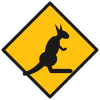
Under this sign is a plate that reads 'Next 40 km'. What does the plate tell you?
A A. Kangaroos are more likely near the road for about 40 kmB B. The kangaroo risk only begins after you drive another 40 kmC C. Kangaroos are only a risk at night for the next 40 kmD D. The next safe rest area is 40 km down the road
Answer each question to see the explanation. Keyboard: A–D or 1–4 to answer, N next, P previous.