Australia road signs and their meanings
43 signs drawn in our own simplified style, with what each one tells you to do. Test yourself in a road-sign quiz:
- NSW road-sign quiz · NSW Driver Knowledge Test (DKT) practice tests
- Victoria road-sign quiz · Victoria learner permit test practice tests
- Queensland road-sign quiz · Queensland Class C PrepL and written road rules test practice tests
- Western Australia road-sign quiz · Western Australia Learner's Permit Computerised Theory Test (CTT) practice tests
- South Australia road-sign quiz · South Australia learner's theory test practice tests
- Tasmania road-sign quiz · Tasmania driver knowledge test practice tests
- Australian Capital Territory road-sign quiz · Australian Capital Territory road rules knowledge test practice tests
- Northern Territory road-sign quiz · Northern Territory driver knowledge test practice tests
Regulatory signs
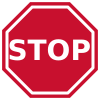
Stop completely at the stop line, then give way to all traffic before moving on.
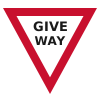
Slow down and stop if needed to let other traffic go first.
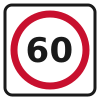
The maximum legal speed until another limit is shown.
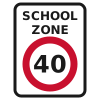
A lower speed limit applies during the school times shown on the sign.
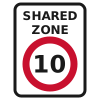
Pedestrians and vehicles share this space; give way to pedestrians and keep to the low limit shown.
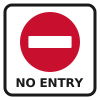
You must not drive into this road from this direction.
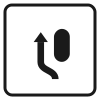
Keep to the left of the island or divider ahead.
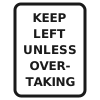
Stay in the left lane except when overtaking; the sign applies on roads where it is posted, which each state sets by speed limit.
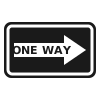
Traffic travels only in the direction of the arrow.
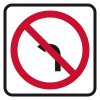
You must not turn left here.
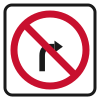
You must not turn right here.
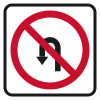
You must not make a U-turn here.
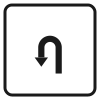
You may make a U-turn here, giving way to all other vehicles and pedestrians.
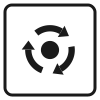
You are entering a roundabout; give way to vehicles already in it and travel clockwise.
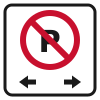
You may stop for up to 2 minutes to drop off or pick up passengers or goods, but must stay within 3 m of the vehicle.
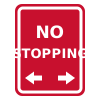
You must not stop at any point in the direction of the arrows unless forced to by traffic or an emergency.
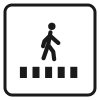
Marks a pedestrian (zebra) crossing; give way to anyone on or entering it.

Marks the level crossing; give way to trains and stop if one is approaching.
Warning signs
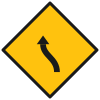
The road bends left ahead; slow to a safe speed before the curve.
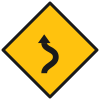
Several bends lie ahead; keep your speed down.
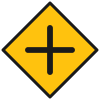
A road crosses ahead; watch for vehicles from both sides.
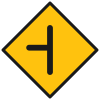
A side road joins from the left ahead.
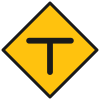
The road ends at a crossing road ahead; you will need to turn left or right.
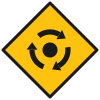
A roundabout is coming up; slow down and prepare to give way.
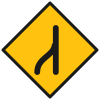
Two lanes become one ahead; merge smoothly and give way as required.
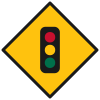
Traffic lights are ahead; be ready to stop.
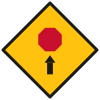
A stop sign is ahead; slow down and prepare to stop.
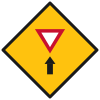
A give way sign is ahead; slow down and be ready to give way.
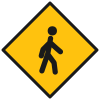
People may be walking on or crossing the road ahead.
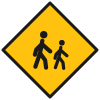
Children may be crossing ahead, often near a school; slow down.
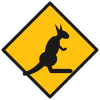
Kangaroos or other wildlife may be on the road; slow down, especially at dawn and dusk.
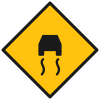
The road may be slippery when wet; slow down.
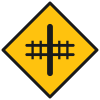
A railway level crossing is ahead; slow down and look for trains.
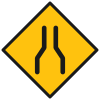
The road becomes narrower ahead; take care with oncoming traffic.
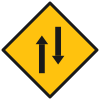
Oncoming traffic shares the road ahead.
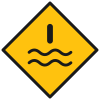
Water may cover the road here; never drive into floodwater.
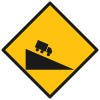
A steep downhill is ahead; slow down and use a lower gear.
Hazard signs

An obstruction is ahead and all traffic must go around it in the direction the chevrons point, here to the left.

An obstruction is ahead and all traffic must go around it in the direction the chevrons point, here to the right.

Marks the nose of an island or obstruction that traffic may pass on either side.
Temporary signs
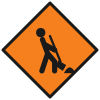
Roadwork is ahead; slow down and follow any temporary speed limit.
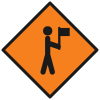
A person with a stop/slow bat is controlling traffic ahead; be ready to stop.
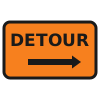
The road is closed ahead; follow the detour route shown.
These drawings are simplified for learning and are not official artwork. Always check the official handbook for your test.