Road-sign questions 20 questions · Pass mark: 16 of 20 (80%) · No time limit
Time taken 0:00
Finish test
Questions
1 2 3 4 5 6 7 8 9 10 11 12 13 14 15 16 17 18 19 20
Question 1 of 20 Signs and markings
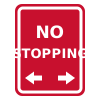
You drive along a street where this sign applies. When may you stop there?
A A. For up to 2 minutes to drop someone off or pick them upB B. For as long as you stay in the carC C. Whenever your hazard lights are onD D. Not at all, unless traffic or an emergency forces you
Question 2 of 20 Signs and markings
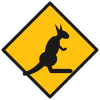
After this sign, at night, a kangaroo freezes in your headlights ahead. You have time to stop. What should you do?
A A. Swerve hard to the right to miss itB B. Brake carefully and sound your hornC C. Speed up so it jumps out of the wayD D. Turn your lights off so it can see
Question 3 of 20 Signs and markings
This sign is on a traffic island in the middle of the road ahead. What must you do?
A A. Pass to the left of the islandB B. Pass to the right of the islandC C. Pass on whichever side is clearD D. Stop before the island and wait
Question 4 of 20 Signs and markings
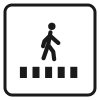
You see this sign beside white stripes on the road. A cyclist is wheeling a bike onto the stripes. What must you do?
A A. Keep going; it is only for walkersB B. Give way to the cyclist on the crossingC C. Sound your horn to warn the cyclistD D. Pass behind the cyclist without slowing
Question 5 of 20 Signs and markings
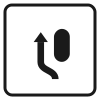
You are driving along a street that has this sign and want to turn right at the next corner. Where should your car be?
A A. As close as practical to the left edgeB B. In the exact middle of the streetC C. As close as practical to the right edgeD D. Wherever there is the least traffic
Question 6 of 20 Signs and markings
At this sign you will take the first exit, less than halfway around. When should you signal left?
A A. Only once you are inside the roundaboutB B. Before you enter, and keep it on until you leaveC C. Only as you pass the exit before yoursD D. Never, as the first exit is close by
Question 7 of 20 Signs and markings
You reach this sign and the red lights beside the track are flashing. No train is in sight yet. What must you do?
A A. Stop and wait until the lights stop flashingB B. Cross quickly before the train arrivesC C. Slow down and cross if you cannot hear a train hornD D. Cross if the boom gates are still up
Question 8 of 20 Signs and markings
You reach this sign at a quiet corner and can see no other traffic. What must you do?
A A. Stop fully behind the line, then go when safeB B. Slow down and roll through if the road is clearC C. Stop only if a car is coming from the rightD D. Sound your horn and drive straight through
Question 9 of 20 Signs and markings
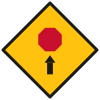
You see this sign on a road with tall hedges. What does it warn you about?
A A. A police check point that is set up just aheadB B. A school crossing that is in use aheadC C. A railway line that has no boom gatesD D. A stop sign ahead that may be hard to see
Question 10 of 20 Signs and markings
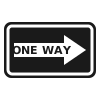
You see this sign at the start of a street. Which way may traffic travel in that street?
A A. In both directions, keeping leftB B. Only the opposite way to the arrowC C. Only in the direction of the arrowD D. Either way outside peak hours
Question 11 of 20 Signs and markings
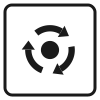
At this sign there are two marked lanes. You plan to go all the way around to head back the way you came. Which lane do you enter from?
A A. The right laneB B. The left laneC C. Either laneD D. The lane with fewer cars
Question 12 of 20 Signs and markings
In the ACT you reach this sign where the track has overhead wires. Your trailer carries a tall load. When must you not cross?
A A. Only if a tram is already on the crossingB B. If the load could come close to the overhead wiresC C. Only between sunset and sunriseD D. Only if the load is wider than the lane
Question 13 of 20 Signs and markings
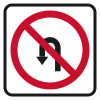
This sign stands beside a road, away from any intersection. Over what stretch must you not make a U-turn?
A A. For 75 metres past the signB B. Only at the exact spot of the signC C. From the sign to the next intersectionD D. Until you pass an end of rule sign
Question 14 of 20 Signs and markings
Your GPS tells you to turn into a lane that has this sign facing you. What should you do?
A A. Follow the GPS, as it knows the wayB B. Turn in slowly with your hazard lights onC C. Ignore that turn and take another routeD D. Turn in if no traffic is coming out
Question 15 of 20 Signs and markings
You stop where this sign applies and walk to the back of the car to unload. How far away can you be before the car counts as unattended?
A A. More than 4 metres awayB B. More than 3 metres awayC C. More than 8 metres awayD D. More than 12 metres away
Question 16 of 20 Signs and markings
After this sign, a child waits at the kerb between parked cars. Why should you slow down even though the child is waiting?
A A. Children always cross where there is a signB B. The law says you must stop for any childC C. Children are easy to see from a long way offD D. Children can act on impulse and step out
Question 17 of 20 Signs and markings
You pass this sign on a cold winter morning near Canberra. Where are icy patches most likely?
A A. In shady spots under trees and on timber bridgesB B. On sunny straight stretches of the roadC C. Only on roads that run beside riversD D. Only in the very middle of the lane
Question 18 of 20 Signs and markings
You see this sign on a rural road near Canberra at dusk. What should you do?
A A. Use high beam and keep the same speed as beforeB B. Sound your horn all the way along the roadC C. Speed up to get through the area quicklyD D. Slow down and watch for animals on the road
Question 19 of 20 Signs and markings
In the ACT you see this sign on a yellow and red island in a busy shopping street. What should you expect?
A A. People may be crossing using the islandB B. Buses will be turning right at the islandC C. The road ends just past the islandD D. Cars may park in the middle of the road
Question 20 of 20 Signs and markings
You see this sign at an intersection, and no other signs or markings apply. Which moves are still allowed there?
A A. Going straight ahead or turning rightB B. Turning left only, after a full stopC C. Turning left only when the lights are greenD D. No moves at all; the road is closed ahead
Answer each question to see the explanation. Keyboard: A–D or 1–4 to answer, N next, P previous.
View
Restart
Turn on JavaScript to answer questions, see explanations and get your score.
Australian road signs and ACT road rules as set out in the ACT Road Rules Handbook ('guidance based on the Road Transport (Road Rules) Regulation 2017'); test categories: car general, alcohol and drugs, intersections, seat belts, driving general and vulnerable road users. 16 correct (80%) is our practice mark, not an official pass mark.
Link to this quiz Driving instructors, schools and learner forums are welcome to link to this free road-sign quiz.
Australia road signs and what they mean Our own simplified drawings of the signs learners meet most. The full list, with meanings, is in the Australia sign library ; the official reference is the ACT Road Rules Handbook .
Regulatory signs Stop
Stop completely at the stop line, then give way to all traffic before moving on.
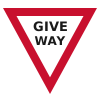
Give way
Slow down and stop if needed to let other traffic go first.
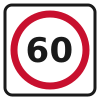
Speed limit
The maximum legal speed until another limit is shown.
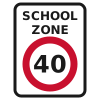
School zone
A lower speed limit applies during the school times shown on the sign.
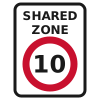
Shared zone
Pedestrians and vehicles share this space; give way to pedestrians and keep to the low limit shown.
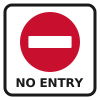
No entry
You must not drive into this road from this direction.
Keep left
Keep to the left of the island or divider ahead.
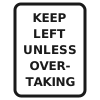
Keep left unless overtaking
Stay in the left lane except when overtaking; the sign applies on roads where it is posted, which each state sets by speed limit.
One way
Traffic travels only in the direction of the arrow.
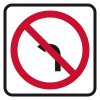
No left turn
You must not turn left here.
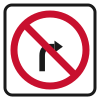
No right turn
You must not turn right here.
No U-turn
You must not make a U-turn here.
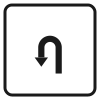
U-turn permitted
You may make a U-turn here, giving way to all other vehicles and pedestrians.
Roundabout
You are entering a roundabout; give way to vehicles already in it and travel clockwise.
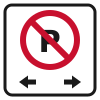
No parking
You may stop for up to 2 minutes to drop off or pick up passengers or goods, but must stay within 3 m of the vehicle.
No stopping
You must not stop at any point in the direction of the arrows unless forced to by traffic or an emergency.
Pedestrian crossing
Marks a pedestrian (zebra) crossing; give way to anyone on or entering it.
Railway level crossing
Marks the level crossing; give way to trains and stop if one is approaching.
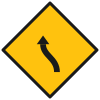
Warning signs Curve to the left
The road bends left ahead; slow to a safe speed before the curve.
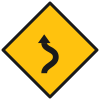
Winding road
Several bends lie ahead; keep your speed down.
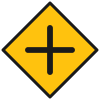
Crossroad ahead
A road crosses ahead; watch for vehicles from both sides.
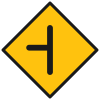
Side road on the left
A side road joins from the left ahead.
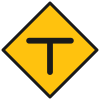
T-junction
The road ends at a crossing road ahead; you will need to turn left or right.
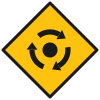
Roundabout ahead
A roundabout is coming up; slow down and prepare to give way.
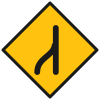
Lanes merge
Two lanes become one ahead; merge smoothly and give way as required.
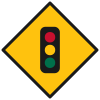
Traffic signals ahead
Traffic lights are ahead; be ready to stop.
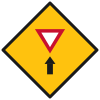
Stop sign ahead
A stop sign is ahead; slow down and prepare to stop.
Give way sign ahead
A give way sign is ahead; slow down and be ready to give way.
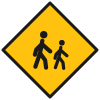
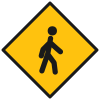
Pedestrians ahead
People may be walking on or crossing the road ahead.
Children crossing ahead
Children may be crossing ahead, often near a school; slow down.
Kangaroos / wildlife
Kangaroos or other wildlife may be on the road; slow down, especially at dawn and dusk.
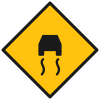
Slippery when wet
The road may be slippery when wet; slow down.
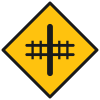
Railway crossing ahead
A railway level crossing is ahead; slow down and look for trains.
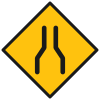
Road narrows
The road becomes narrower ahead; take care with oncoming traffic.
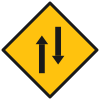
Two-way traffic ahead
Oncoming traffic shares the road ahead.
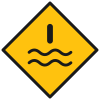
Road subject to flooding
Water may cover the road here; never drive into floodwater.
Hazard signs Hazard marker (pass on the left)
An obstruction is ahead and all traffic must go around it in the direction the chevrons point, here to the left.
Hazard marker (pass on the right)
An obstruction is ahead and all traffic must go around it in the direction the chevrons point, here to the right.
Hazard marker (pass either side)
Marks the nose of an island or obstruction that traffic may pass on either side.
Next Advertisement