Question 1 of 40 Road signs
You come to this sign. There is no stop line and no crosswalk. Where should you stop?
A A. In the middle of the intersection, so you can see both waysB B. Before you enter the intersection, where you can seeC C. Next to the sign post, even if you cannot seeD D. Nowhere; with no line you only need to slow down
Question 2 of 40 Signals and pavement markings (Minnesota)
A lane use control signal over a Minnesota freeway lane shows a steady downward yellow arrow (not an X). What does it mean?
A A. You may keep using that lane with careB B. That lane is for left turns onlyC C. Traffic in that lane may go either wayD D. Prepare to move over; the lane below will close
Question 3 of 40 Road signs
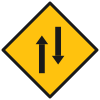
You are on a one-way street and see this sign. What does it mean?
A A. The road ahead is one-way the other wayB B. Two lanes merge into one lane aheadC C. Traffic will soon come toward you on this roadD D. You may now pass on either side of the car ahead
Question 4 of 40 Right of way
A school bus is stopped with red lights flashing and its stop arm out on a two-lane road. What must you do?
A A. Pass slowly if no children are seenB B. Stop only if you are behind the busC C. Sound your horn and go aroundD D. Stop, whichever way you are going
Question 5 of 40 Road signs
Why do stop and yield signs have shapes no other sign uses?
A A. So drivers can tell them apart even from behindB B. Because those shapes are cheaper to makeC C. So both signs can fit on the same poleD D. Because they are only used in big cities
Question 6 of 40 Safe driving and hazards
Strong winds are blowing across the road. What should you do?
A A. Slow down and grip the wheel firmlyB B. Speed up to get through it fasterC C. Drive on the shoulder until it stopsD D. Follow a truck closely for cover
Question 7 of 40 Signals and pavement markings (Minnesota)
At a Minnesota freeway ramp meter, what should you do?
A A. Wait for the green, then one car goesB B. Go right after the car ahead of you goesC C. Ignore it unless traffic is heavyD D. Stop only if the light flashes
Question 8 of 40 Sharing the road
How much of the lane does a motorcycle need?
A A. Half a lane, so two can ride side by sideB B. The full width of a laneC C. Just the shoulder of the roadD D. One third of a lane
Question 9 of 40 Sharing the road
A large truck ahead is signaling a right turn and has swung left. What should you do?
A A. Pass it quickly on the right sideB B. Honk and squeeze by on the leftC C. Stay back and do not pass on the rightD D. Pull up close behind it and wait
Question 10 of 40 Parking and stopping (Minnesota)
In Minnesota, how close to a stop sign or traffic signal at the side of the road may you park?
A A. No closer than 15 feetB B. No closer than 30 feetC C. No closer than 40 feetD D. No closer than 60 feet
Question 11 of 40 Alcohol, drugs and penalties (Minnesota)
In Minnesota, a driver can be arrested for DWI with an alcohol concentration of at least what?
A A. 0.05 percentB B. 0.08 percentC C. 0.10 percentD D. 0.12 percent
Question 12 of 40 Road signs
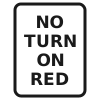
What does this sign mean while the light is red?
A A. You may turn right after a full stopB B. You may turn only if no one is comingC C. You must turn and may not go straightD D. You may not turn, even after you stop
Question 13 of 40 Speed and following distance (Minnesota)
Which rule helps you keep a safe gap behind the car ahead in Minnesota?
A A. The three-second ruleB B. The one-second ruleC C. The two-second ruleD D. The ten-second rule
Question 14 of 40 Right of way
A green light lets you go straight, but a car is still turning left in front of you from the last light. What should you do?
A A. Go, since your light is green nowB B. Let it finish its turn before you goC C. Honk so it hurries out of the wayD D. Drive around the back of it
Question 15 of 40 Alcohol, drugs and penalties
Some cold medicines warn they may cause drowsiness. What does this mean for driving?
A A. They have no effect on drivingB B. They help you stay alertC C. They can make driving unsafeD D. They are only a problem at night
Question 16 of 40 Safe driving and hazards
Where is it now advised that you place your hands on the wheel?
A A. At about 12 o'clockB B. At about 6 o'clock, low on the wheelC C. One hand at the very topD D. At about 9 and 3 o'clock
Question 17 of 40 Emergencies and equipment
Your right wheels drift off the edge of the pavement. What should you do?
A A. Jerk the wheel back right awayB B. Brake hard while still on the edgeC C. Ease off the gas and steer back gentlyD D. Speed up to climb back onto the road
Question 18 of 40 Alcohol, drugs and penalties
What can happen if you get many traffic tickets in a short time?
A A. You get a safe-driving rewardB B. Your license lasts longerC C. Your license can be suspendedD D. Your insurance goes down
Question 19 of 40 Speed and following distance
What is the "basic speed rule"?
A A. Never drive faster than is safe for conditionsB B. Always drive at exactly the posted limitC C. Drive at the same speed as the car aheadD D. Drive as fast as the road and your car allow
Question 20 of 40 Road signs
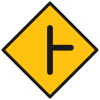
What should you expect after you pass this sign?
A A. Cars may enter from a road on the rightB B. Your road ends and you must turn rightC C. The right lane is closed aheadD D. The road bends sharply to the right
Question 21 of 40 Sharing the road
An orange triangle with a red border on the back of a vehicle means:
A A. It carries dangerous goodsB B. It is a slow-moving vehicleC C. It is a school bus or vanD D. It is broken down or stalled
Question 22 of 40 Safe driving and hazards
How far should you sit from the airbag in the steering wheel?
A A. About 2 inchesB B. About 5 inchesC C. It does not matterD D. At least 10 inches
Question 23 of 40 Alcohol, drugs and penalties
Which factor can raise a person's blood alcohol level?
A A. Drinking slowly with a mealB B. Drinking quickly on an empty stomachC C. Drinking water between each drinkD D. Waiting a few hours before driving
Question 24 of 40 Right of way
A school bus ahead of you has flashing yellow lights. What does this mean?
A A. It is letting children off nowB B. You may pass it with careC C. It is getting ready to stopD D. It is broken down
Question 25 of 40 Turning, passing and lanes
Why should you avoid changing lanes in an intersection?
A A. It is fine if you signal before the intersectionB B. Others may not expect it, and it can cause a crashC C. It saves time and keeps traffic movingD D. It is only a problem at night or in rain
Question 26 of 40 Right of way (Minnesota)
You reach an uncontrolled "T" intersection in Minnesota and must turn. According to the manual, whom must you yield to?
A A. Only traffic coming from your rightB B. All cross trafficC C. No one, if you got there firstD D. Only other turning vehicles
Question 27 of 40 Speed and following distance (Minnesota)
What happens in Minnesota if you drive over 100 mph?
A A. Your license is revoked for at least six monthsB B. You get a warning on a first offenseC C. You must retake the written test onlyD D. Your license is suspended for one week
Question 28 of 40 Parking and stopping
You park facing uphill next to a curb. Which way should you turn your front wheels?
A A. Toward the curbB B. Straight aheadC C. Away from the curbD D. It does not matter
Question 29 of 40 Safe driving and hazards
You see children playing near the road ahead. What is a good step to take?
A A. Speed up to get past them before they moveB B. Honk the whole timeC C. Move to the center lineD D. Cover the brake so you can stop fast
Question 30 of 40 Sharing the road (Minnesota)
In Minnesota, lane splitting by motorcycles in moving traffic is allowed at no more than what speed?
A A. 15 mphB B. 25 mphC C. 40 mphD D. 50 mph
Question 31 of 40 Road signs
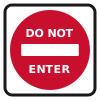
Where are you most likely to see this sign?
A A. At the start of a school zone near a playgroundB B. Just before a railroad crossing with gatesC C. At the end of a one-way road or exit rampD D. At the entrance to a parking lot
Question 32 of 40 Parking and stopping
Traffic is backed up and you are about to cross railroad tracks. What should you do?
A A. Stop on the tracks until traffic moves onB B. Drive onto the tracks and wait thereC C. Back up into the car behind youD D. Wait until there is room past the tracks
Question 33 of 40 Turning, passing and lanes
You are waiting to turn left with oncoming traffic. How should you hold your front wheels?
A A. Straight ahead until you start to turnB B. Turned to the left, ready to goC C. Turned a little to the rightD D. It does not matter how they point
Question 34 of 40 Turning, passing and lanes
Where should you slow down when leaving a highway?
A A. In the exit lane, after leaving the main lanesB B. In the main lanes, before you reach the exitC C. On the shoulder, before the exit rampD D. In the left lane, so others can pass
Question 35 of 40 Turning, passing and lanes
You need to turn at the next intersection. When should you get into the correct lane?
A A. In the middle of the intersectionB B. Right at the stop lineC C. Well before the intersectionD D. After you turn
Question 36 of 40 Turning, passing and lanes
May you drive on the shoulder to pass a car turning left?
A A. No, unless signs or markings allow itB B. Yes, whenever there is room on itC C. Yes, as long as you honk firstD D. Yes, if traffic behind you is light
Question 37 of 40 Turning, passing and lanes
You are passing a car and an oncoming car appears sooner than you thought. What is the best thing to do?
A A. Drop back behind the car you were passingB B. Speed up and finish the pass anywayC C. Drive onto the left shoulder to let it byD D. Honk and stay where you are beside it
Question 38 of 40 Alcohol, drugs and penalties
What is a likely result of driving while your license is suspended?
A A. Your license is given back earlyB B. A small fine like a parking ticketC C. More fines and a longer suspension or jailD D. No penalty as long as you drive safely
Question 39 of 40 Turning, passing and lanes (Minnesota)
When passing on a Minnesota two-lane road, you must be back on the right side before you come within how far of an oncoming vehicle?
A A. 60 feetB B. 100 feetC C. 250 feetD D. 400 feet
Question 40 of 40 Right of way (Minnesota)
A blind pedestrian with a white cane is at a Minnesota crosswalk near you. What should you NOT do?
A A. Stop and wait for the personB B. Give the person extra timeC C. Honk or rev your engineD D. Watch for a guide dog as well
Answer each question to see the explanation. Keyboard: A–D or 1–4 to answer, N next, P previous.