Question 1 of 40 Road signs
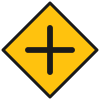
What does this sign tell you is ahead?
A A. A railroad crossing aheadB B. Another road crosses yoursC C. A hospital entranceD D. The end of a divided road
Question 2 of 40 Road signs (Minnesota)
In Minnesota, the slow-moving vehicle emblem must be shown on vehicles that travel at what speed or less?
A A. 12 mphB B. 18 mphC C. 30 mphD D. 45 mph
Question 3 of 40 Road signs
A sign shaped like a triangle with one point facing down means:
A A. StopB B. No passing zoneC C. YieldD D. Road work ahead
Question 4 of 40 Road signs
A blue sign with a white "H" tells you:
A A. A hotel is nearbyB B. A helicopter pad is nearbyC C. A hospital is nearbyD D. A highway begins here
Question 5 of 40 Road signs
A five-sided sign shaped like a house warns of:
A A. A hospital or clinic just aheadB B. A school zone or school crossingC C. A rest area with picnic tablesD D. A parking area for buses
Question 6 of 40 Parking and stopping
May you park in a marked bike lane?
A A. Yes, for a short stop of a few minutesB B. Generally no, since it blocks cyclistsC C. Yes, if no bikes are coming at the timeD D. Yes, at night when few people ride
Question 7 of 40 Emergencies and equipment (Minnesota)
Under Minnesota law, children under what age must ride in the back seat if one is available?
A A. Under 8B B. Under 10C C. Under 13D D. Under 11
Question 8 of 40 Sharing the road
When may a cyclist ride in the middle of a traffic lane?
A A. Never; cyclists must stay at the edgeB B. Only on highways and freewaysC C. When the lane is too narrow to share safelyD D. Only at night with lights on
Question 9 of 40 Sharing the road
A vehicle is stopped on the shoulder with flashing emergency lights. What should you do?
A A. Keep your speed and stay in your laneB B. Stop in your lane until it leavesC C. Speed up to pass it quicklyD D. Move over a lane, or slow down
Question 10 of 40 Safe driving and hazards (Minnesota)
According to the Minnesota manual, about how deep must water be to reach the bottom of most passenger cars?
A A. 1 footB B. 2 inchesC C. 3 feetD D. 6 inches
Question 11 of 40 Sharing the road (Minnesota)
When you pass a bicyclist in Minnesota, how much space must you leave?
A A. At least 3 feetB B. At least 1 footC C. At least 2 feetD D. At least 6 feet
Question 12 of 40 Road signs
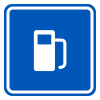
What does this blue sign beside the highway tell you?
A A. Fuel is available at or near the next exitB B. A fuel tanker may be on the roadC C. You must stop for a vehicle checkD D. The highway has a rest area with no services
Question 13 of 40 Parking and stopping (Minnesota)
In Minnesota, how close to the nearest rail of a railroad crossing may you park?
A A. No closer than 15 feetB B. No closer than 50 feetC C. No closer than 25 feetD D. No closer than 80 feet
Question 14 of 40 Right of way
A person starts to cross against a "DON'T WALK" signal in front of you. What should you do?
A A. Yield and let them crossB B. Keep going, since they are in the wrongC C. Honk and drive around themD D. Speed up so they step back
Question 15 of 40 Turning, passing and lanes
How should you turn left from a one-way street onto another one-way street?
A A. From the right lane into the right laneB B. From the far left lane into the far left laneC C. From the left lane into the right laneD D. From any lane into whatever lane is open
Question 16 of 40 Safe driving and hazards
The headlights of an oncoming car are blinding you. Where should you look?
A A. Straight into the oncoming lightsB B. Toward the right edge of your laneC C. At the center line next to the carD D. Down at your dashboard until it passes
Question 17 of 40 Right of way
You turn right on a green light. A person is crossing the street you are turning onto. Who has the right-of-way?
A A. You do, since your light is greenB B. Whoever reached the corner firstC C. The person crossingD D. You do, if you signaled early
Question 18 of 40 Parking and stopping
Why should you not park in front of a fire station driveway?
A A. It is private land owned by the cityB B. The road is wider there than usualC C. Fire trucks must leave fastD D. It is a stop for city buses
Question 19 of 40 Right of way
You are turning right on red. Who must you yield to?
A A. No one, once you have come to a stopB B. People crossing and cross traffic on greenC C. Only cars coming from your rightD D. Only buses and trucks on the cross street
Question 20 of 40 Road signs
Which sign is the only one with eight sides?
A A. YieldB B. Railroad crossing aheadC C. School zoneD D. Stop
Question 21 of 40 Emergencies and equipment
How should you set your head restraint?
A A. As low as it will go on the seatB B. Level with your neck or shouldersC C. Removed, so it is more comfortableD D. Level with the back of your head
Question 22 of 40 Alcohol, drugs and penalties
How does alcohol affect your vision at night?
A A. It slows how fast your eyes recover from glareB B. It makes you see better in the darkC C. It has no effect on your vision at nightD D. It only changes how you see colors
Question 23 of 40 Parking and stopping
When you park on a hill, what else should you always do?
A A. Leave the engine runningB B. Turn on your hazardsC C. Set the parking brakeD D. Leave the car in neutral
Question 24 of 40 Signals and pavement markings
The light turns yellow just as you reach the stop line at speed and cannot stop safely. What should you do?
A A. Slam on the brakes and stop wherever you areB B. Speed up to beat the red lightC C. Stop in the middle of the crosswalkD D. Go on through the intersection with care
Question 25 of 40 Right of way
You want to make a U-turn where it is legal. Who must you yield to?
A A. Only cars coming toward youB B. No one, as long as you signalC C. Only the cars behind youD D. All other traffic and pedestrians
Question 26 of 40 Right of way (Minnesota)
A Minnesota postal truck is stopped with its warning lights on, on a road with two lanes going your way. What must you do?
A A. Nothing, since it is not an emergency vehicleB B. Stop behind it until it drives awayC C. Honk to warn the driver as you passD D. Move to the lane farthest from it, if safe
Question 27 of 40 Turning, passing and lanes (Minnesota)
In Minnesota, at least how far before a turn must you turn on your signal?
A A. 25 feetB B. 60 feetC C. 100 feetD D. 250 feet
Question 28 of 40 Turning, passing and lanes
After passing a car, when should you move back into its lane?
A A. When you can see its headlights in your mirrorB B. Right after you pull even with its frontC C. Before you pass its front bumper fullyD D. When its driver honks or waves at you
Question 29 of 40 Sharing the road
When are cyclists hardest for drivers to see?
A A. At dusk, at night, and in bad weatherB B. At noon on a clear, dry dayC C. When they ride in a bike laneD D. When they wear bright clothes
Question 30 of 40 Emergencies and equipment (Minnesota)
Your car hits a utility pole in Minnesota and catches fire, so you must get out. How should you leave?
A A. Step out slowly holding the doorB B. Crawl out and lie flat on the groundC C. Jump with both feet together and shuffle awayD D. Run away taking long strides
Question 31 of 40 Road signs
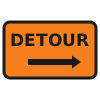
What does this sign tell you to do?
A A. Stop and wait for the road to openB B. Use the shoulder to get past the workC C. Follow the signs around a closed roadD D. Turn around and go back the way you came
Question 32 of 40 Turning, passing and lanes
What is the acceleration lane on a highway on-ramp for?
A A. To speed up to match highway trafficB B. To stop and wait for a gap in trafficC C. To pass slow cars on the highwayD D. To park if you have an emergency
Question 33 of 40 Speed and following distance
Why does the risk of hydroplaning go up as you drive faster?
A A. Your brakes get too hot to work wellB B. Your engine starts to use more fuelC C. Your headlights get dimmer at speedD D. Your tires cannot push water away fast enough
Question 34 of 40 Right of way
A cyclist on your right and you arrive at an all-way stop together. What should you do?
A A. Go first, since bikes must always yieldB B. Let the cyclist go firstC C. Go first if you are going straightD D. Go first, since your vehicle is larger
Question 35 of 40 Speed and following distance
Why is following too closely dangerous?
A A. It uses more fuel than leaving a gapB B. You may not be able to stop in timeC C. It makes your car louder insideD D. It is only a problem at night
Question 36 of 40 Speed and following distance
The road is wet from rain. What should you do?
A A. Keep your usual speed and laneB B. Slow down and leave more spaceC C. Use cruise control to stay steadyD D. Follow closer to see the road better
Question 37 of 40 Speed and following distance
What can make your reaction time longer?
A A. Wearing a seat belt that is too tightB B. Being tired or distractedC C. Driving in bright daylightD D. Using your mirrors often
Question 38 of 40 Parking and stopping
When you finish parallel parking, where should your car be?
A A. At an angle, with the back sticking outB B. Close to and lined up with the curbC C. Touching the bumper of the car behindD D. With two wheels up on the sidewalk
Question 39 of 40 Licensing and insurance (Minnesota)
How long is a Minnesota instruction permit valid?
A A. Six monthsB B. Two yearsC C. One yearD D. Three years
Question 40 of 40 Emergencies and equipment (Minnesota)
In Minnesota, a child who has outgrown a car seat must use a booster seat between what ages?
A A. 1 to 3 years oldB B. 4 to 9 years oldC C. 6 to 12 years oldD D. 7 to 11 years old
Answer each question to see the explanation. Keyboard: A–D or 1–4 to answer, N next, P previous.