US traffic signs, signals and pavement markings as shown in the Kansas Driving Handbook (AAMVA model manual); the test asks applicants to 'identify certain signs by their shape, color, or the symbol appearing on them'. 16 correct (80%) is our practice mark, not an official pass mark.
Road-sign questions 20 questions · Pass mark: 16 of 20 (80%) · No time limit
Time taken 0:00
0 /20 answered
Finish test
Questions
1 2 3 4 5 6 7 8 9 10 11 12 13 14 15 16 17 18 19 20
Question 1 of 20 Road signs
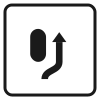
At night you pass this sign just after you turn onto a ramp. What is the best thing to do?
A A. Pull over, then turn around safelyB B. Keep driving to the next exit and get off thereC C. Speed up so you leave the ramp soonerD D. Flash your headlights and keep going
Question 2 of 20 Road signs
What does this sign tell you to do?
A A. Turn right at the next streetB B. Stay in the right lane until the road endsC C. Pass to the right of the island aheadD D. Move right to let faster cars pass you
Question 3 of 20 Road signs
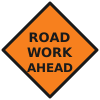
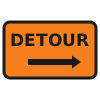
What does this orange sign tell you?
A A. The road ahead is closed, so turn aroundB B. There is road work ahead, so slow downC C. A detour begins right hereD D. A flagger has stopped all traffic ahead
Question 4 of 20 Road signs
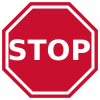
You come to this sign. There is no stop line and no crosswalk. Where should you stop?
A A. In the middle of the intersection, so you can see both waysB B. Before you enter the intersection, where you can seeC C. Next to the sign post, even if you cannot seeD D. Nowhere; with no line you only need to slow down
Question 5 of 20 Road signs
What does this sign tell you about the road ahead?
A A. A side road joins from the leftB B. It ends, and you must turn left or rightC C. Two lanes merge into one lane aheadD D. It splits into two branches, left and right
Question 6 of 20 Road signs
What does this sign mean?
A A. The road gets narrow on both sidesB B. Two roads join into one roadC C. A right turn is coming upD D. The right lane ends ahead
Question 7 of 20 Road signs
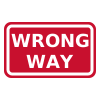
You see this sign facing you. What does it mean?
A A. You are driving against trafficB B. You took a wrong turn but may keep goingC C. The road ahead has a sharp curveD D. You are on a road that has no exit
Question 8 of 20 Road signs
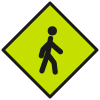
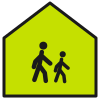
What does this sign warn you about?
A A. People may be crossing the road aheadB B. A school bus stop is just ahead on the rightC C. Cars are not allowed in a park aheadD D. The sidewalk ahead is closed
Question 9 of 20 Road signs
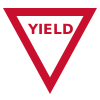
You reach this sign as a car with the right-of-way is coming. What should you do?
A A. Keep your speed if you got to the sign firstB B. Slow down or stop and let that car go firstC C. Flash your lights so the other driver waitsD D. Speed up to get through before the car arrives
Question 10 of 20 Road signs
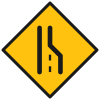
What does this sign warn you about?
A A. You must turn right at the next streetB B. The road curves to the right aheadC C. The right lane ends aheadD D. A road joins from the right ahead
Question 11 of 20 Road signs
What does this sign warn you about?
A A. Your lane ends and you must stop at the endB B. The road splits into two roadsC C. Another lane of traffic will join yoursD D. Two-way traffic is ahead on this road
Question 12 of 20 Road signs
What does this sign tell you?
A A. The speed you must always drive at on this roadB B. The lowest speed allowed on this roadC C. A suggested speed for trucks and buses onlyD D. The top legal speed when conditions are good
Question 13 of 20 Road signs
What may you not do where this sign is posted?
A A. Turn left onto a side street from this laneB B. Park along the right curb for a short timeC C. Change lanes to pass a carD D. Turn around to go back the way you came
Question 14 of 20 Road signs
What does this sign tell you?
A A. A public park is just aheadB B. A hospital zone is just aheadC C. A school is near and children may crossD D. The road ahead is for people on foot only
Question 15 of 20 Road signs
What should you do when you see this sign?
A A. Stop right next to this signB B. Slow down and get ready to stopC C. Speed up before the light changesD D. Move over to the left lane
Question 16 of 20 Road signs
Where would you expect to see this sign?
A A. On the outside edge of a sharp curveB B. At a crosswalk near a school or parkC C. On a one-way road near an exitD D. Where a lane comes to an end
Question 17 of 20 Road signs
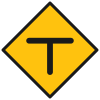
What does this sign tell you about the road ahead?
A A. The highway ends just ahead at a stop signB B. A median will split the two directionsC C. Two roads cross just aheadD D. You must keep left of an island
Question 18 of 20 Road signs
Your lane has this sign over it. What must you do at the intersection?
A A. Go straight or turn leftB B. Turn rightC C. Turn leftD D. Make a U-turn
Question 19 of 20 Road signs
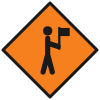
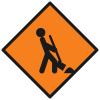
What should you be ready to do after you pass this sign?
A A. Drive on, since it is not for carsB B. Sound your horn to warn the workers you are comingC C. Speed up to get through the work areaD D. Follow the signals of a worker directing traffic
Question 20 of 20 Road signs
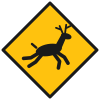
Why are deer crossing signs placed where they are on Kansas roads?
A A. The state feeds deer near the signB B. Many deer have been hit by cars thereC C. Hunting is allowed just past the signD D. The road ahead runs through a state park
Answer each question to see the explanation. Keyboard: A–D or 1–4 to answer, N next, P previous.
View
Restart
Turn on JavaScript to answer questions, see explanations and get your score.
Link to this quiz Driving instructors, schools and learner forums are welcome to link to this free road-sign quiz.
United States road signs and what they mean Our own simplified drawings of the signs learners meet most. The full list, with meanings, is in the United States sign library ; the official reference is the Kansas Driving Handbook (Non-Commercial Driver's Manual) .
Regulatory signs Stop
Come to a complete stop at the line, crosswalk or intersection edge, then go only when the way is clear.
Yield
Slow down and let traffic and pedestrians that have the right-of-way go first, stopping if needed.
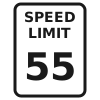
Speed limit
The highest legal speed on this road under ideal conditions.
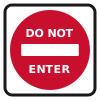
Do not enter
You must not drive into this road or ramp from this direction.
Wrong way
You are driving against traffic; stop safely and turn around.
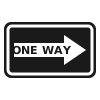
One way
Traffic on this road moves only in the direction of the arrow.
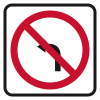
No left turn
Left turns are not allowed here.
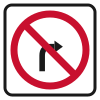
No right turn
Right turns are not allowed here.
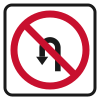
No U-turn
Turning around to go back the way you came is not allowed here.
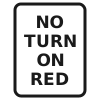
No turn on red
You may not turn while the signal is red, even after stopping.
Keep right
Pass to the right of the island or obstruction ahead.
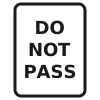
Do not pass
Overtaking other vehicles is not allowed on this stretch.
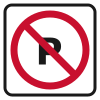
No parking
You may not park here; stopping briefly to load or unload may still be allowed where local rules say so.
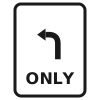
Left turn only lane
Vehicles in this lane must turn left.
Railroad crossing (crossbuck)
Marks the crossing itself; yield to any train and stop if one is coming.
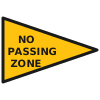
Warning signs No passing zone
Marks the start of a stretch where passing is not allowed; it sits on the left side of the road.
Curve to the right
The road bends gently to the right ahead; slow down before the bend.
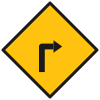
Sharp turn to the right
The road turns sharply right ahead; slow down a lot before the turn.
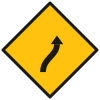
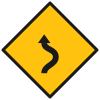
Winding road
A series of bends lies ahead; keep speed down until the road straightens.
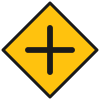
Crossroad ahead
Another road crosses yours ahead; watch for traffic from both sides.
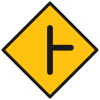
Side road
A road joins from the right ahead; expect vehicles entering.
T-intersection
The road you are on ends ahead at a crossing road; be ready to turn left or right.
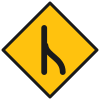
Merge
Traffic from another lane or ramp will join yours ahead; adjust speed so both can merge safely.
Lane ends
The right lane ends ahead; drivers in it must move left when safe.
Divided highway begins
A median will separate the two directions of traffic ahead; keep right of it.
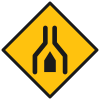
Divided highway ends
The median ends ahead and traffic in both directions will share one road.
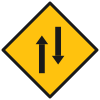
Two-way traffic
You are leaving a one-way road; oncoming traffic will use the same road ahead.
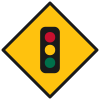
Traffic signal ahead
There is a traffic light ahead; be ready to stop.
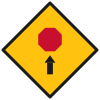
Stop sign ahead
A stop sign is coming up; slow down and prepare to stop.
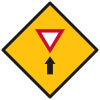
Yield sign ahead
A yield sign is coming up; slow down and be ready to give way.
Pedestrian crossing
People may be crossing ahead; slow down and yield to anyone in the crosswalk.
School zone / school crossing
A school is near and children may be crossing; slow down and obey any school speed limit.
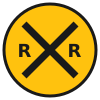
Railroad crossing ahead
A railroad crossing is ahead; slow down, look and listen for trains.
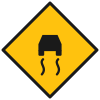
Slippery when wet
The surface gets slick in rain; slow down and avoid sudden braking or steering.
Deer crossing
Deer often cross here, especially at dawn and dusk; slow down and watch the roadsides.
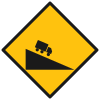
Hill / steep grade
A steep downgrade is ahead; check your speed and use a lower gear.
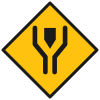
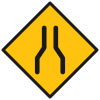
Narrow bridge
The bridge ahead is narrower than the road; slow down and watch for oncoming vehicles.
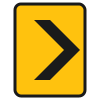
Chevron alignment
Marks the outside of a sharp curve and shows the direction to steer.
Temporary signs Road work ahead
Construction is ahead; slow down, expect changes and obey work-zone signs.
Flagger ahead
A worker is directing traffic ahead; follow their signals.
Workers ahead
People are working on or next to the road; slow down and give them space.
Detour
The usual route is closed; follow the detour signs in the arrow direction.
Next Advertisement