Question 1 of 25 Road signs
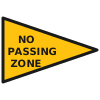
Why is this sign placed on the left side of the road?
A A. Because it is meant for oncoming traffic onlyB B. So it does not block the shoulderC C. So a driver about to pass will see itD D. Because it warns of a curve to the left
Question 2 of 25 Sharing the road
How much of the lane does a motorcycle need?
A A. Half a lane, so two can ride side by sideB B. The full width of a laneC C. Just the shoulder of the roadD D. One third of a lane
Question 3 of 25 Turning, passing and lanes
You are waiting to turn left with oncoming traffic. How should you hold your front wheels?
A A. Straight ahead until you start to turnB B. Turned to the left, ready to goC C. Turned a little to the rightD D. It does not matter how they point
Question 4 of 25 Parking and stopping (Kansas)
On a long Kansas downgrade, may you stop or park in the area of a truck runaway ramp?
A A. No, never stop or park thereB B. Yes, for up to one hourC C. Yes, but only at nightD D. Yes, to check a map
Question 5 of 25 Speed and following distance
You see brake lights far ahead on the highway. What should you do?
A A. Speed up to close the gap to themB B. Brake hard right away to be safeC C. Ease off the gas and get ready to slowD D. Change lanes at once without looking
Question 6 of 25 Speed and following distance
The road is wet from rain. What should you do?
A A. Keep your usual speed and laneB B. Slow down and leave more spaceC C. Use cruise control to stay steadyD D. Follow closer to see the road better
Question 7 of 25 Sharing the road
You want to pass a cyclist on a narrow road with oncoming cars. What should you do?
A A. Wait behind until you can pass safelyB B. Squeeze by between the bike and carsC C. Honk to make the rider move overD D. Pass on the right side instead
Question 8 of 25 Sharing the road (Kansas)
In Kansas, a city transit bus stops to let people off. Unlike a school bus, when must you stop for it?
A A. Always, from both directionsB B. Only when its red lights flashC C. Only when you are behind itD D. Only on two-lane roads
Question 9 of 25 Alcohol, drugs and penalties
What can happen if you get many traffic tickets in a short time?
A A. You get a safe-driving rewardB B. Your license lasts longerC C. Your license can be suspendedD D. Your insurance goes down
Question 10 of 25 Speed and following distance
How does higher speed affect what you can see?
A A. Your side vision narrowsB B. Your side vision widensC C. You see more detail at the sidesD D. It has no effect
Question 11 of 25 Road signs
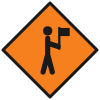
What should you be ready to do after you pass this sign?
A A. Drive on, since it is not for carsB B. Sound your horn to warn the workers you are comingC C. Speed up to get through the work areaD D. Follow the signals of a worker directing traffic
Question 12 of 25 Safe driving and hazards
Why is driving at night riskier than in the day?
A A. Roads are busier at night than by dayB B. You cannot see as far or as clearlyC C. Speed limits are higher at nightD D. Cars run worse when it is cold
Question 13 of 25 Emergencies and equipment (Kansas)
Your car breaks down on a Kansas highway. How far behind it does the manual say to place flares?
A A. About 25 to 35 feetB B. About 40 to 60 feetC C. About 200 to 300 feetD D. About 800 to 1,000 feet
Question 14 of 25 Right of way (Kansas)
According to the Kansas Driving Handbook, besides school buses, which buses must you stop for when they stop to load or unload children?
A A. City transit buses and trolleysB B. Church buses and day care busesC C. Tour buses and charter busesD D. Airport shuttles and hotel vans
Question 15 of 25 Parking and stopping
Your car is parked on a downhill slope beside a curb. How should the front wheels point?
A A. Away from the curbB B. Straight aheadC C. Toward the middle of the roadD D. Toward the curb
Question 16 of 25 Speed and following distance
You are towing a trailer. How should your following distance change?
A A. Leave less space than usualB B. Keep the same space as usualC C. Follow close to cut windD D. Leave more space than usual
Question 17 of 25 Right of way
When must you yield the right-of-way?
A A. Whenever it helps prevent a crashB B. Only when a sign tells you toC C. Only to police cars and fire trucksD D. Never, if you have a green light
Question 18 of 25 Signals and pavement markings
What does a flashing yellow light mean?
A A. Stop and wait for a green lightB B. Slow down and go on with careC C. The light is about to turn redD D. The road ahead is closed
Question 19 of 25 Signals and pavement markings
A flashing "DON'T WALK" or raised hand signal means people on foot should:
A A. Cross quickly before it turns steadyB B. Stop and wait in the middle of the roadC C. Cross only if they can run the whole wayD D. Not start, but finish if already crossing
Question 20 of 25 Licensing and insurance (Kansas)
When are all age-related limits lifted from a Kansas restricted license?
A A. After age 16, once it has been held for 3 monthsB B. After age 16, once it has been held for 6 monthsC C. At age 20, no matter how long it was heldD D. After age 16, once it has been held for 9 months
Question 21 of 25 Speed and following distance
Why do many states raise fines for speeding in a work zone?
A A. To pay for the cost of road repairsB B. Because work zones have more policeC C. Workers are close to traffic and can be hurtD D. Because cars use more fuel in work zones
Question 22 of 25 Signals and pavement markings (Kansas)
In Kansas, what does a single solid white line between two lanes going the same way tell you?
A A. You may change lanes freely across itB B. Stay in your lane unless a change is neededC C. The lane on the left is only for busesD D. Oncoming traffic is on the other side of it
Question 23 of 25 Parking and stopping
Why is it unsafe to stop or park on railroad tracks?
A A. A train could hit your carB B. It can damage your tiresC C. It is only unsafe at nightD D. It blocks people walking
Question 24 of 25 Sharing the road
You stop behind a large truck on an uphill slope. Why should you leave extra space?
A A. It may roll back when it starts to moveB B. It may need to back up to make a turnC C. Its exhaust is too hot to be nearD D. It may drop part of its load on you
Question 25 of 25 Road signs
A "LOW CLEARANCE" sign shows a height. What does it warn you about?
A A. A road that dips under water when it rainsB B. A speed limit for tall trucksC C. A narrow lane with little room at the sidesD D. An overpass or bridge with limited space above
The timer starts when you answer the first question. Keyboard: A–D or 1–4 to answer, N next, P previous.