Question 1 of 36 Signals and pavement markings (California)
When may you turn left against a red light in California?
A A. From a two-way street onto a one-way streetB B. From a one-way street onto a one-way streetC C. Whenever no cars are coming toward youD D. Only between midnight and 5 a.m.
Question 2 of 36 Road signs
A sign and a police officer at an intersection give you different orders. Whom do you obey?
A A. The signB B. Whichever is closer to youC C. The police officerD D. Whichever is more cautious
Question 3 of 36 Alcohol, drugs and penalties
What usually happens if you refuse a lawful breath or blood test?
A A. Nothing, it is your rightB B. Your license can be suspendedC C. You get a warning onlyD D. You must take a driving class
Question 4 of 36 Road signs
A sign shaped like a triangle with one point facing down means:
A A. StopB B. No passing zoneC C. YieldD D. Road work ahead
Question 5 of 36 Right of way
You are turning left into a driveway across the oncoming lane. Who must you yield to?
A A. Only the cars that are behind youB B. No one, since you have signaledC C. Oncoming traffic and people on the sidewalkD D. Only large trucks coming toward you
Question 6 of 36 Speed and following distance
Why is following distance measured in seconds instead of feet?
A A. Feet are only used for trucksB B. Seconds stay right at any speedC C. Seconds are shorter than feetD D. Feet change with the weather
Question 7 of 36 Speed and following distance (California)
What is the speed limit at a California blind intersection?
A A. 15 mphB B. 20 mphC C. 25 mphD D. 30 mph
Question 8 of 36 Safe driving and hazards (California)
In California, a child of what age may not be left alone in a vehicle?
A A. Two years old or youngerB B. Ten years old or youngerC C. Six years old or youngerD D. Under sixteen years old
Question 9 of 36 Road signs
A blue sign with a white "H" tells you:
A A. A hotel is nearbyB B. A helicopter pad is nearbyC C. A hospital is nearbyD D. A highway begins here
Question 10 of 36 Sharing the road (California)
How much space must you leave when passing a bicyclist in California?
A A. At least 1 footB B. At least 2 feetC C. At least 3 feetD D. At least 5 feet
Question 11 of 36 Turning, passing and lanes
May you drive on the shoulder to pass a car turning left?
A A. No, unless signs or markings allow itB B. Yes, whenever there is room on itC C. Yes, as long as you honk firstD D. Yes, if traffic behind you is light
Question 12 of 36 Speed and following distance
When you are stopped behind another car, how much space should you leave?
A A. Enough to see its rear tires touch the roadB B. About one foot, so no one can cut inC C. None; pull right up to its bumperD D. Enough room to fit two more cars
Question 13 of 36 Sharing the road
You are turning right and a cyclist is riding in the bike lane next to you. What should you do?
A A. Let the cyclist pass, then turnB B. Turn in front of the cyclistC C. Honk, then make your turnD D. Speed up so you turn first
Question 14 of 36 Road signs
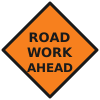
What does this orange sign tell you?
A A. The road ahead is closed, so turn aroundB B. There is road work ahead, so slow downC C. A detour begins right hereD D. A flagger has stopped all traffic ahead
Question 15 of 36 Alcohol, drugs and penalties
You see a car weaving across lanes ahead. What should you do?
A A. Keep well back and report it when safeB B. Pass it quickly to get away from itC C. Follow closely so you can watch itD D. Honk until it pulls over
Question 16 of 36 Safe driving and hazards
You are driving on a two-lane road and an oncoming car drifts into your lane. What should you do?
A A. Steer left into its laneB B. Slow down, honk, and steer rightC C. Speed up to get past it firstD D. Stop in your lane and wait
Question 17 of 36 Speed and following distance
You are towing a trailer. How should your following distance change?
A A. Leave less space than usualB B. Keep the same space as usualC C. Follow close to cut windD D. Leave more space than usual
Question 18 of 36 Licensing and insurance (California)
What are the minimum liability insurance amounts in California?
A A. $15,000 / $30,000 / $5,000B B. $25,000 / $50,000 / $25,000C C. $30,000 / $60,000 / $15,000D D. $50,000 / $100,000 / $50,000
Question 19 of 36 Turning, passing and lanes
When you back up, where should you look?
A A. Only in your side mirrors, both sidesB B. Only at the backup camera screenC C. Straight ahead, while you steer backD D. Over your right shoulder through the rear window
Question 20 of 36 Emergencies and equipment
When should you use your hazard warning lights?
A A. When parking in a no-parking zoneB B. When your stopped car could be a hazardC C. When driving in light rain or mistD D. When you are late and driving fast
Question 21 of 36 Road signs
On an Interstate route sign, what does an odd route number usually tell you?
A A. The highway runs mostly east and westB B. The highway is a toll road for its whole lengthC C. The highway loops around a cityD D. The highway runs mostly north and south
Question 22 of 36 Speed and following distance
You are going too fast as you enter a curve. What is the best thing to do?
A A. Brake hard in the middle of the curveB B. Speed up so you get through it fasterC C. Turn the wheel sharply toward the insideD D. Ease off the gas and steer smoothly through it
Question 23 of 36 Sharing the road
You are behind a truck and cannot see its side mirrors. What does this mean?
A A. You are at a safe distanceB B. The truck is about to stopC C. The truck driver cannot see youD D. The truck has no side mirrors at all
Question 24 of 36 Right of way
At a four-way stop, who should go first?
A A. The driver in the biggest vehicleB B. The driver going the fastestC C. The driver turning leftD D. The driver who stopped first
Question 25 of 36 Right of way
You hear a siren and see a fire truck with flashing lights behind you. What should you do?
A A. Speed up to stay well ahead of itB B. Stop right where you are in your laneC C. Pull to the right edge of the road and stopD D. Pull to the left edge and keep going
Question 26 of 36 Turning, passing and lanes
Where is a U-turn most likely to be unsafe or not allowed?
A A. On a quiet street with a clear view both waysB B. At a light that has a U-turn arrowC C. Near a curve or hill where others cannot see youD D. On a wide road with no traffic in sight
Question 27 of 36 Signals and pavement markings
A striped area of white lines lies between a highway lane and an exit ramp. What should you do?
A A. Use it to slow down for the exitB B. Do not drive on it except in an emergencyC C. Use it to pass slow carsD D. Park on it if you break down
Question 28 of 36 Parking and stopping (California)
In California, how close to a marked or unmarked crosswalk may you park?
A A. No closer than 5 feetB B. No closer than 10 feetC C. No closer than 30 feetD D. No closer than 20 feet
Question 29 of 36 Emergencies and equipment (California)
You are in a California collision with $1,500 in property damage. What must you file?
A A. A police report within 30 daysB B. Nothing, if no one is hurtC C. An insurance claim onlyD D. An SR 1 report with DMV within 10 days
Question 30 of 36 Turning, passing and lanes
Before you change lanes, how should you check your blind spot?
A A. Look in the rear-view mirror onlyB B. Turn your head and look over your shoulderC C. Watch the car in front of you closelyD D. Look in your side mirror one more time
Question 31 of 36 Safe driving and hazards
Where is ice most likely to form first?
A A. On roads in tunnelsB B. On busy city streets at noonC C. On bridges and overpassesD D. On roads near the coast
Question 32 of 36 Road signs
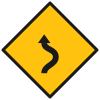
What lies ahead when you see this sign?
A A. A slippery road surfaceB B. A steep hill aheadC C. A series of curvesD D. A narrow bridge
Question 33 of 36 Turning, passing and lanes
Why should you avoid changing lanes in an intersection?
A A. It is fine if you signal before the intersectionB B. Others may not expect it, and it can cause a crashC C. It saves time and keeps traffic movingD D. It is only a problem at night or in rain
Question 34 of 36 Turning, passing and lanes (California)
On a California two-lane road, you are driving slowly with vehicles behind you. When must you use a turnout to let them pass?
A A. When any vehicle is following youB B. Only when someone flashes their lightsC C. Only on roads with a 55 mph limitD D. When five or more vehicles are following you
Question 35 of 36 Right of way (California)
In California, pedestrians using guide dogs or white canes have the right-of-way when?
A A. Only in marked crosswalksB B. Only at traffic signalsC C. Only in daylightD D. At all times
Question 36 of 36 Safe driving and hazards
When should you turn on your headlights?
A A. Only after the sun has fully setB B. Any time it is hard to seeC C. Only in cities with streetlightsD D. Only on highways
Answer each question to see the explanation. Keyboard: A–D or 1–4 to answer, N next, P previous.