Question 1 of 40 Rules of the road · Safe driving and hazards
In Nova Scotia, a collision causes injury or property damage of $2,000 or more. How soon must it be reported?
A A. Within 12 hoursB B. Within 48 hoursC C. Within 24 hoursD D. Within 72 hours
Question 2 of 40 Rules of the road · Right-of-way
In Nova Scotia, which of these stopped vehicles must you also slow down and move over for?
A A. A taxi stopped at the curb to drop off a passengerB B. A delivery van parked at the curbC C. A school bus with its amber lights offD D. A tow truck helping a vehicle at a collision
Question 3 of 40 Rules of the road
In Nova Scotia, you are driving so slowly that traffic is building up behind you. What must you do?
A A. Stop where it is safe and let the traffic passB B. Turn on your hazard lights and keep goingC C. Speed up to well above the posted limitD D. Move onto the shoulder while still moving
Question 4 of 40 Rules of the road · Safe driving and hazards
It starts to rain after a long dry spell. When is the road most slippery?
A A. Only after it has rained for an hourB B. Only once deep puddles have formedC C. In the first 10 to 15 minutes of rainD D. Only when it rains after dark
Question 5 of 40 Rules of the road · Licensing and insurance
In Nova Scotia, who must ride with you while you drive on a learner's licence?
A A. Any licensed driver in the back seatB B. An experienced driver in the front seatC C. A parent, but only after darkD D. No one, once you pass the test
Question 6 of 40 Rules of the road · Safe driving and hazards
In the rain, what following distance should you keep behind the vehicle ahead?
A A. One second or moreB B. Four seconds or moreC C. Three seconds or moreD D. Half a second or more
Question 7 of 40 Rules of the road · Right-of-way
You are leaving a parking lot onto a street. Who must you yield to?
A A. All vehicles and pedestriansB B. Only vehicles coming from the leftC C. Only pedestrians on the sidewalkD D. No one, if you signal clearly
Question 8 of 40 Rules of the road · Sharing the road
You plan to pass a large commercial truck. What should you allow?
A A. Less room, as trucks are slowB B. Extra room when you passC C. The same room as for a carD D. No room, since trucks move over
Question 9 of 40 Rules of the road · Speed and following distance
The posted limit is 80 km/h, but the road is wet and foggy. How fast should you drive?
A A. At a speed that is safe for the conditionsB B. At 80 km/h, as the sign allowsC C. A little above 80 km/h, to stay with trafficD D. At any speed you feel sure about
Question 10 of 40 Rules of the road · Licensing and insurance
You are 17 and want a learner's licence in Nova Scotia. What extra thing do you need?
A A. A letter from your high school principalB B. Proof that you own a car in your nameC C. Written consent from a parent or guardianD D. A doctor's report on your general health
Question 11 of 40 Rules of the road
You are joining a controlled-access (100-series) highway from an entrance ramp. What must you do?
A A. Stop at the end of the ramp in every caseB B. Merge at once; highway traffic must let you inC C. Drive on the shoulder until a lane is emptyD D. Yield to through traffic until there is a safe gap
Question 12 of 40 Rules of the road · Alcohol, drugs and penalties
Police suspect you are impaired and the roadside screening device reads "fail". What happens next?
A A. You may leave if there are no other violationsB B. You get a written warning and drive homeC C. You must book a road test within the weekD D. You are arrested and taken for a breathalyzer test
Question 13 of 40 Rules of the road · Turning, passing and lanes
In Nova Scotia, what must you do just before you overtake and pass another vehicle?
A A. Flash your lights and brakeB B. Move onto the right shoulderC C. Signal and sound your hornD D. Turn on your hazard lights
Question 14 of 40 Rules of the road · Safe driving and hazards
You drive into a tunnel on a bright, sunny day. What should you do?
A A. Speed up to get through the tunnel quicklyB B. Slow down, remove sunglasses, turn on headlightsC C. Keep sunglasses on and use parking lightsD D. Switch to high beams and stay in the left lane
Question 15 of 40 Rules of the road
What is a safety scan?
A A. Moving your head and eyes often to check all aroundB B. Looking only at the road straight ahead of your vehicleC C. Checking your mirrors once before you startD D. Watching the car in front and nothing else
Question 16 of 40 Rules of the road · Safe driving and hazards
On wet roads, at about what speed can a standard car's tires ride totally on top of the water?
A A. About 65 km/hB B. About 85 km/hC C. About 75 km/hD D. About 95 km/h
Question 17 of 40 Rules of the road · Alcohol, drugs and penalties
What is the only thing that removes alcohol from your body?
A A. Time, as the liver slowly breaks it downB B. Drinking several cups of strong black coffeeC C. Taking a cold shower before you driveD D. Going for a fast jog around the block
Question 18 of 40 Rules of the road · Safe driving and hazards
During a storm, several snow plows are staggered across the highway, clearing all lanes. What should you do?
A A. Pass between them where the gap is widestB B. Pass them on the right-hand shoulderC C. Stay behind them; never pass between themD D. Sound your horn so they move aside
Question 19 of 40 Rules of the road · Licensing and insurance
What is the minimum age to get a Class 7 learner's licence in Nova Scotia?
A A. 15 years oldB B. 16 years oldC C. 17 years oldD D. 21 years old
Question 20 of 40 Rules of the road · Safe driving and hazards
In winter, which parts of the road usually freeze before the rest?
A A. Wide, sunny stretches of open highway in the countryB B. Roads near the centre of a large cityC C. Bridges, overpasses and shaded sectionsD D. Freshly paved roads in a busy area
Question 21 of 40 Road signs · Signs, signals and road markings
The centre lane of a multi-lane highway is a two-way-left-turn lane. What must you never use it for?
A A. Slowing down to turn leftB B. Waiting for a gap to turn leftC C. Passing another vehicleD D. Turning left into a driveway
Question 22 of 40 Road signs · Signs, signals and road markings
A flashing light unit shows its lamps in a straight bar with no arrowheads. What does this mean?
A A. It is safe to pass the unit on either of its sidesB B. There is a hazard; it does not mean passing is safeC C. The lane ahead is open again and work has endedD D. You must stop and wait for a flag person to signal
Question 23 of 40 Road signs · Signs, signals and road markings
On a two-lane road, the centre markings are a broken yellow line on your side and a solid yellow line on the other side. What does this mean for you?
A A. You may not pass, but oncoming drivers mayB B. You may pass with care when it is safeC C. You may pass only if the other driver wavesD D. You may not pass in either direction here
Question 24 of 40 Road signs · Signs, signals and road markings
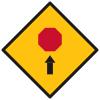
You pass this sign on a rural road. What does it tell you?
A A. You must stop right now, beside this signB B. A school bus stop is coming up on the roadC C. Stopping is not allowed on the road aheadD D. A stop sign is ahead, so be ready to stop
Question 25 of 40 Road signs · Signs, signals and road markings
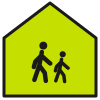
In Nova Scotia, the posted limit just before this school zone is 80 km/h. Children are present. What is the most you may drive?
A A. 30 km/hB B. 45 km/hC C. 50 km/hD D. 65 km/h
Question 26 of 40 Road signs · Signs, signals and road markings
In Nova Scotia, a driver with a parking permit uses a space with the accessible parking sign. Where must the permit be?
A A. Hung from the rearview mirrorB B. Taped inside the back windowC C. Placed face up on the dashboardD D. Clipped to the driver's sun visor
Question 27 of 40 Road signs · Signs, signals and road markings
In a Nova Scotia work zone, you see a white square sign with two cars inside a red circle with a slash. What is true about it?
A A. It is only advice; you may pass if it looks clearB B. It is a rule; ignoring it can get you a ticketC C. It applies only to trucks, buses and big vehiclesD D. It applies only at night, when the lights are dim
Question 28 of 40 Road signs · Signs, signals and road markings
In Nova Scotia, a warning sign shows that a steep decline is ahead. What may you need to do?
A A. Use a higher gear to save on fuelB B. Shift into neutral and coast downC C. Turn on your hazard lights and stopD D. Use a lower gear going down the hill
Question 29 of 40 Road signs · Signs, signals and road markings
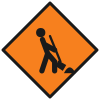
In a Nova Scotia work zone, what does this sign tell you?
A A. A detour starts at the next cornerB B. Workers are active at the siteC C. All of the road work has now endedD D. Trucks will cross from a side road
Question 30 of 40 Road signs · Signs, signals and road markings
In Nova Scotia, what do yellow lines on the road tell you about the lanes they separate?
A A. Traffic in those lanes moves in the same directionB B. One of those lanes is kept for slow vehicles onlyC C. Traffic in those lanes moves in opposite directionsD D. Both of those lanes are kept for turning vehicles
Question 31 of 40 Road signs · Signs, signals and road markings
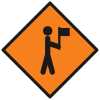
You pass this sign as you near road work in Nova Scotia. What is going on ahead?
A A. Children may be crossing the road to a school close byB B. A police check stop has been set up just down the roadC C. Survey crews are measuring the land beside the roadD D. Traffic control persons are directing traffic with paddles
Question 32 of 40 Road signs · Signs, signals and road markings
A traffic light ahead of you turns yellow (amber). What does it mean?
A A. Stop before the intersection if you can stop safelyB B. Speed up so that you clear the intersection before redC C. Keep your speed, since yellow only means to go with careD D. Stop at once, even if you are already in the intersection
Question 33 of 40 Road signs · Signs, signals and road markings
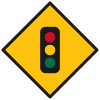
As you drive, you see this sign. What should you expect ahead?
A A. A railway crossing with flashing lightsB B. A police check stop on the roadC C. Traffic signal lights coming up soonD D. A fire hall with an emergency light
Question 34 of 40 Road signs · Signs, signals and road markings
In Nova Scotia, you reach the solid line at the end of a climbing lane. Who has the right of way?
A A. The vehicle in the left laneB B. The faster of the two vehiclesC C. The larger of the two vehiclesD D. The vehicle in the right lane
Question 35 of 40 Road signs · Signs, signals and road markings
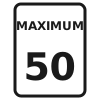
In Nova Scotia, what does the speed on this sign tell you?
A A. The speed you must keep up in every kind of weatherB B. The lowest speed you may drive at on this roadC C. A suggested speed that you do not have to obeyD D. The fastest speed allowed when conditions are ideal
Question 36 of 40 Road signs · Signs, signals and road markings
A flashing light unit in a work zone shows a single arrowhead pointing right. How may you pass it?
A A. Only on the right side, as the arrow showsB B. On either side, whichever looks clearer to youC C. Only on the left side, away from the arrowheadD D. You may not pass it at all until work is done
Question 37 of 40 Road signs · Signs, signals and road markings
In Nova Scotia, you see a white sign showing two cars inside a red circle with a slash. What does it mean?
A A. Passing is allowed here with careB B. Do not pass other vehicles hereC C. Two lanes merge into one just aheadD D. Watch for cars coming from the side
Question 38 of 40 Road signs · Signs, signals and road markings
You are driving over railway tracks when the warning lights start to flash. What should you do?
A A. Keep moving and finish crossing the tracksB B. Stop at once and wait for the train to passC C. Back up off the tracks the way you cameD D. Stop and wait for the gate to rise again
Question 39 of 40 Road signs · Signs, signals and road markings
In Nova Scotia, when may you act differently from what a regulatory sign tells you?
A A. When no other traffic is in sightB B. When the sign is on a quiet rural roadC C. When you know the road very wellD D. When a peace officer directs you to
Question 40 of 40 Road signs · Signs, signals and road markings
You face a red light at a corner with a crosswalk but no marked stop line. Where must you stop?
A A. In the middle of the crosswalk, for a better viewB B. Past the crosswalk, just before the cross streetC C. At the near side of the crosswalkD D. Beside the light pole on the far corner
Answer each question to see the explanation. Keyboard: A–D or 1–4 to answer, N next, P previous.