Question 1 of 40 Rules of the road
Why is driving slowly just past the top of a hill especially dangerous?
A A. Your brakes do not work well after a climbB B. Faster cars may not see you in time to slow downC C. Slow cars on hills are against the lawD D. Oncoming cars always have the right of way on a hill
Question 2 of 40 Rules of the road · Alcohol, drugs and penalties
You are convicted of impaired driving under the Criminal Code of Canada. Where are you banned from driving?
A A. Only in Nova ScotiaB B. Anywhere in CanadaC C. Only on 100-series highwaysD D. Only in the county of the offence
Question 3 of 40 Rules of the road · Right-of-way
At an intersection with no painted crosswalk, a pedestrian is crossing. What must you do?
A A. Yield, since every intersection has a crosswalkB B. Go first, because the crosswalk is not marked on the roadC C. Honk so the pedestrian hurries acrossD D. Yield only if the pedestrian is a child
Question 4 of 40 Rules of the road · Right-of-way
In Nova Scotia, a stopped city transit bus signals that it wants to pull back into traffic. The posted limit is 50 km/h. What should you do?
A A. Speed up so you can pass before it pulls out from the stopB B. Sound your horn so the bus stays putC C. Yield and let the bus move back into trafficD D. Pass it on the left without slowing
Question 5 of 40 Rules of the road · Parking and stopping
In Nova Scotia, when you park at a curb, how close must your curbside wheels be?
A A. Within 25 cmB B. Within 15 cmC C. Within 40 cmD D. Within 50 cm
Question 6 of 40 Rules of the road · Right-of-way
In Nova Scotia, an emergency vehicle has stopped to help at a collision. How close may you drive or park?
A A. No closer than 40 metresB B. No closer than 150 metresC C. No closer than 90 metresD D. No closer than 120 metres
Question 7 of 40 Rules of the road · Speed and following distance
You use the two-second rule and reach the landmark before you finish counting. What does that tell you?
A A. You are following too closelyB B. You are keeping a safe distanceC C. You are driving under the limitD D. The car ahead is going too fast
Question 8 of 40 Rules of the road · Alcohol, drugs and penalties
In Nova Scotia, how many demerit points lead to a six-month suspension for a fully licensed driver who is not in the GDL program?
A A. 8 pointsB B. 10 pointsC C. 12 pointsD D. 14 points
Question 9 of 40 Rules of the road · Parking and stopping
You leave your car parked and unattended. What must you do?
A A. Leave the engine running if you will only be gone a minuteB B. Turn on the four-way flashers onlyC C. Leave the car in neutral with the keyD D. Set the parking brake and turn off the engine
Question 10 of 40 Rules of the road · Right-of-way
You want to turn left. An oncoming car at the same intersection is going straight. Who must yield?
A A. The driver going straight aheadB B. Whoever arrived at the corner lastC C. You, the driver turning leftD D. Neither, if both drivers signal
Question 11 of 40 Rules of the road
In Nova Scotia, what does sounding your horn before you pass do to the driver ahead?
A A. It puts them under a legal duty to help you passB B. It gives you the right to pass in a no-passing zoneC C. It means they must speed up to let you byD D. It warns them that you plan to turn left
Question 12 of 40 Rules of the road · Speed and following distance
How do you use the two-second rule?
A A. Look at your speedometer every two secondsB B. Stay two car lengths back at any speedC C. When the car ahead passes a landmark, count two secondsD D. Brake for two seconds whenever the car ahead brakes
Question 13 of 40 Rules of the road · Licensing and insurance
In Nova Scotia, at which GDL stage may you first upgrade to a higher licence class (1 to 4)?
A A. The learner's licence stageB B. The newly licensed stageC C. The restricted individual stageD D. Only after you leave GDL
Question 14 of 40 Rules of the road · Licensing and insurance
How much time do you have to finish each part of the Nova Scotia Class 7 knowledge test?
A A. 20 minutesB B. 30 minutesC C. 45 minutesD D. 60 minutes
Question 15 of 40 Rules of the road
While backing up, you take off your seat belt so you can turn to see. What must you remember?
A A. Fasten it again before moving forwardB B. Keep it off until the end of your tripC C. Only the driver may ever take it offD D. Ask a passenger to steer for you
Question 16 of 40 Rules of the road · Licensing and insurance
In Nova Scotia, you fail your road test. How long must you wait before trying again?
A A. At least three daysB B. At least two weeksC C. At least one weekD D. At least three weeks
Question 17 of 40 Rules of the road · Safe driving and hazards
In Nova Scotia, a child weighs more than 18 kg but is under 145 cm tall and under 9 years old. What must they ride in?
A A. A rear-facing infant seatB B. A booster seatC C. A seat belt only, in the front seatD D. A forward-facing seat on a lap
Question 18 of 40 Rules of the road · Safe driving and hazards
A seat has a front airbag. Which child seat must never be used in it?
A A. A booster seat for an older childB B. A forward-facing seat with a tetherC C. Any seat, once the child is over 10D D. A rear-facing child seat
Question 19 of 40 Rules of the road
In Nova Scotia, when must you use your signal lights instead of hand signals?
A A. When you drive a car that has an automatic transmissionB B. Only after dark or in heavy rain or snowC C. Only when you are turning at a traffic lightD D. When your vehicle or load blocks the view of your arm
Question 20 of 40 Rules of the road · Licensing and insurance
In Nova Scotia, during which hours may a newly licensed (Class 5N) driver NOT drive alone, without an exemption?
A A. Between 10:00 p.m. and 6:00 a.m.B B. Between 11:00 p.m. and 4:00 a.m.C C. Between midnight and 5:00 a.m.D D. Between 9:00 p.m. and 7:00 a.m.
Question 21 of 40 Road signs · Signs, signals and road markings
In Nova Scotia, a warning sign tells you that a bridge opening is ahead. What does it mean?
A A. The bridge has just been opened to trafficB B. The bridge can be opened to let boats passC C. The bridge is narrower than the road leading to itD D. The bridge has a low clearance above the road
Question 22 of 40 Road signs · Signs, signals and road markings
What must you do when you come to this sign?
A A. Slow down and keep going if no cars are coming toward youB B. Come to a complete stop, then go only when the way is clearC C. Stop only if other vehicles or people are near the cornerD D. Sound your horn, then go through at a slower speed
Question 23 of 40 Road signs · Signs, signals and road markings
In Nova Scotia, you reach a corner where the traffic lights are not working. How should you treat it?
A A. As a multi-stop: stop fully, then go when it is your turnB B. As a yield sign: slow down and go on if no one is comingC C. As a green light for whichever road carries more trafficD D. As a flashing yellow: slow down and drive through with care
Question 24 of 40 Road signs · Signs, signals and road markings
Signs like this one are often posted in a group. What are they for?
A A. To guide drivers around a sharp curveB B. To mark a stretch where you may passC C. To show the way to a detour routeD D. To point to the nearest exit ramp
Question 25 of 40 Road signs · Signs, signals and road markings
In Nova Scotia, you are stopped at a red light and want to turn right. No sign forbids it. What may you do?
A A. Turn right without stopping if no other cars are comingB B. Wait for green, since all turns on a red light are illegalC C. Turn right only if a police officer waves you throughD D. Turn right after a full stop, once you are sure it is safe
Question 26 of 40 Road signs · Signs, signals and road markings
In Nova Scotia, on a highway with a climbing lane, a posted sign can tell slow vehicles to use four-way flashers. Below what speed does this apply?
A A. 45 km/hB B. 65 km/hC C. 70 km/hD D. 90 km/h
Question 27 of 40 Road signs · Signs, signals and road markings
You waited at a railway crossing while a train passed. What should you do before you cross?
A A. Sound your horn to warn people nearbyB B. Cross at once while the lights still flashC C. Check that no other train is comingD D. Flash your headlights at the other cars
Question 28 of 40 Road signs · Signs, signals and road markings
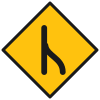
You see this sign where two lanes are about to join. Who is responsible for a smooth merge?
A A. Only the drivers in the lane that endsB B. Drivers in both lanes share that dutyC C. Only the drivers already in the main laneD D. Only the drivers of large trucks and buses
Question 29 of 40 Road signs · Signs, signals and road markings
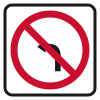
What does this sign mean?
A A. Left turns are not permitted hereB B. Left turns are allowed after a full stopC C. The road ahead bends sharply to the leftD D. Only left turns may be made from this lane
Question 30 of 40 Road signs · Signs, signals and road markings
The centre line is made of two solid yellow lines side by side. May you cross them to pass?
A A. No, not in either directionB B. Yes, if the car ahead is going slowlyC C. Yes, if you can see far enough aheadD D. Yes, but only during daylight hours
Question 31 of 40 Road signs · Signs, signals and road markings
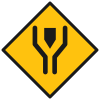
What change in the road does this sign warn you about?
A A. The road is about to become a divided highwayB B. The divided highway is about to come to an endC C. The road splits into two separate routesD D. A lane is closed for repairs up ahead
Question 32 of 40 Road signs · Signs, signals and road markings
In Nova Scotia, what do most warning signs look like?
A A. A white rectangle with red or black lettersB B. A yellow diamond with black letters or symbolsC C. A green rectangle with white lettersD D. A red circle with a slash across it
Question 33 of 40 Road signs · Signs, signals and road markings
On a multi-lane road, one lane is closed ahead for road work. When should you merge?
A A. As soon as you can do it safelyB B. At the very last moment before the closureC C. Only after you pass the first road workerD D. Only when a driver behind flashes the lights
Question 34 of 40 Road signs · Signs, signals and road markings
In Nova Scotia, work zone signs that show a symbol of a person are used only when what is true?
A A. The work is planned to start next weekB B. Workers are on site and could be hitC C. The road has gone back to normal againD D. The site has been closed for the night
Question 35 of 40 Road signs · Signs, signals and road markings
In a work zone, an orange sign warns that the road will narrow. What does this tell you about the lanes?
A A. One lane will close, so you must merge overB B. The road becomes one lane for both directionsC C. The shoulder ends, but lanes keep their widthD D. Lanes get narrower, but there are just as many
Question 36 of 40 Road signs · Signs, signals and road markings
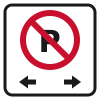
In Nova Scotia, what does this sign with arrows pointing both ways mean?
A A. No parking on either side of where the sign standsB B. No parking unless your hazard lights are flashingC C. Parking is allowed only facing the way traffic flowsD D. Two-way traffic is ahead, so keep to the right side
Question 37 of 40 Road signs · Signs, signals and road markings
In Nova Scotia, what causes the most crashes in work zones?
A A. Vehicles going at different speedsB B. Workers stepping out onto the roadC C. Loose gravel on the road surfaceD D. Drivers using their high beams
Question 38 of 40 Road signs · Signs, signals and road markings
In Nova Scotia, you see someone driving carelessly through a work zone. What should you do?
A A. Follow the driver to get the plateB B. Flash your lights and honk at themC C. Pass the driver to get out of the wayD D. Report the driver to the police
Question 39 of 40 Road signs · Signs, signals and road markings
In Nova Scotia, a white square sign shows an arrow pointing straight up inside a green circle. What does it mean?
A A. One-way street; traffic flows the way shownB B. Passing lane; you may pass on the left sideC C. No turns; you may only go straight aheadD D. Through road; cross traffic must stop for you
Question 40 of 40 Road signs · Signs, signals and road markings
Near a school, a crosswalk guard holds up a stop paddle facing your car. What must you do?
A A. Slow down and pass if no child is in your laneB B. Stop and obey the guard's signalC C. Sound your horn and drive around the guardD D. Stop only if you can see children on the road
Answer each question to see the explanation. Keyboard: A–D or 1–4 to answer, N next, P previous.