Question 1 of 50 Licensing and insurance
In B.C., what is the shortest time you must hold a learner's licence before the Class 7 road test?
A A. 3 monthsB B. 6 monthsC C. 12 monthsD D. 24 months
Question 2 of 50 Licensing and insurance
In B.C., how many multiple-choice questions are on the knowledge test?
A A. 25 questionsB B. 40 questionsC C. 50 questionsD D. 100 questions
Question 3 of 50 Licensing and insurance
In B.C., how much notice must you give to cancel a road test without a fee, if you have no valid reason?
A A. 12 hoursB B. 24 hoursC C. 48 hoursD D. 72 hours
Question 4 of 50 Licensing and insurance
In B.C., a novice driver has no supervisor. How many passengers who are not immediate family may they carry?
A A. Two passengersB B. Three passengersC C. No passengersD D. One passenger
Question 5 of 50 Signs, signals and road markings
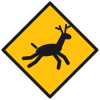
What does this sign warn you about?
A A. Deer may be on the road aheadB B. A wildlife park is nearbyC C. Hunting is allowed in this areaD D. Farm animals cross here daily
Question 6 of 50 Signs, signals and road markings
You plan to use the lane shown by this sign to turn into a driveway. What should you watch for in the lane?
A A. Drivers using it to pass slower trafficB B. Buses that have first right to use itC C. Parked cars pulling out from the curbD D. Drivers coming the other way to turn left
Question 7 of 50 Sharing the road
A cyclist ahead of you holds their right arm straight out to the side. What are they signalling?
A A. A right turnB B. A left turnC C. That they will stopD D. That you may pass
Question 8 of 50 Signs, signals and road markings
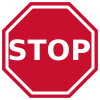
What must you do at this sign?
A A. Slow down, and go on if no cars are comingB B. Stop only when other vehicles are already thereC C. Sound your horn, then drive through with careD D. Stop fully, then go only when it is safe
Question 9 of 50 Sharing the road
In B.C., which rules must a person riding a horse on a public road obey?
A A. Only the rules that apply to pedestriansB B. Only the rules that apply to cyclistsC C. Their own set of rules, apart from driversD D. The same rules as drivers of motor vehicles
Question 10 of 50 Speed and following distance
In B.C., unless a sign says otherwise, what is the speed limit within cities and towns?
A A. 30 km/hB B. 50 km/hC C. 60 km/hD D. 70 km/h
Question 11 of 50 Parking and stopping
You park uphill beside a low, rolling curb that a car could roll over. Which way should the wheels be turned?
A A. To the left, as with a normal curbB B. Straight, with the parking brake setC C. To the right, as if there were no curbD D. To the left, then shift to neutral
Question 12 of 50 Signs, signals and road markings
In B.C., a playground zone sign has a 30 km/h tab. When does that limit apply?
A A. School days, 8 a.m. to 5 p.m.B B. Every day, from dawn to duskC C. Weekdays, 7 a.m. to 7 p.m.D D. Only when you see children
Question 13 of 50 Signs, signals and road markings
In B.C., a train has passed a crossing and the gate is starting to rise. When may you go?
A A. As soon as the gate starts to riseB B. When the gate is fully up and it is safeC C. As soon as the train has gone byD D. When the bell stops, even if the gate is down
Question 14 of 50 Turning, passing and lanes
You are turning onto a street that has a reserved lane you are not allowed to use. Which lane should you turn into?
A A. The lane next to the reserved laneB B. The reserved lane, then move over laterC C. The reserved lane, for one block onlyD D. Whichever lane has the least traffic
Question 15 of 50 Signs, signals and road markings
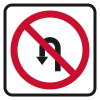
What does this sign tell you?
A A. You may turn around only on a green lightB B. You must turn left at the next cornerC C. The road ahead bends back sharplyD D. You may not turn around to go back
Question 16 of 50 Speed and following distance
You drive around a curve. How does your speed change the pull of inertia on your vehicle?
A A. It stays the same at every speedB B. It gets smaller as you go fasterC C. It matters only when you are brakingD D. The faster you go, the greater it is
Question 17 of 50 Signs, signals and road markings
In B.C., the advance green arrow at the bottom of the regular lights goes off. Only the green light is left. What may you do to turn left?
A A. Wait for the next green arrow before you turn leftB B. Turn left after yielding to pedestrians and oncoming trafficC C. Turn left at once, since oncoming traffic is stoppedD D. Turn left only after first coming to a full stop
Question 18 of 50 Safe driving and hazards
Which air temperature is often the most dangerous for winter driving?
A A. About −10°CB B. About −20°CC C. About −30°CD D. About 0°C
Question 19 of 50 Licensing and insurance
In B.C., a learner's licence is valid for two years. What must you do to renew it?
A A. Pass the Class 7 road testB B. Pass the knowledge test againC C. Show a full driver experience logD D. Pay a fee, with no test needed
Question 20 of 50 Parking and stopping
You are pulling out from a line of parked cars, and your turn signal may be hard to see. What should you do?
A A. Sound your horn instead of signallingB B. Turn on your hazard lights and pull outC C. Pull out quickly before anyone comesD D. Use a hand signal as well as your turn signal
Question 21 of 50 Licensing and insurance
In B.C., how long may a new resident drive on a valid licence from another province or country?
A A. The first 30 daysB B. The first 60 daysC C. The first 180 daysD D. The first 90 days
Question 22 of 50 Signs, signals and road markings
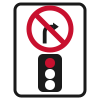
What does this sign mean?
A A. Wait for green before turning rightB B. Turn right on red after a full stopC C. Turn right on red without stoppingD D. Right turns are banned at all times
Question 23 of 50 Speed and following distance
You are on a rural B.C. highway, well outside any town, and see no speed sign. What is the most you may drive?
A A. 70 km/hB B. 80 km/hC C. 90 km/hD D. 100 km/h
Question 24 of 50 Signs, signals and road markings
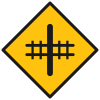
In B.C., a train is coming and you must stop at this sign. How far from the nearest rail should you stop?
A A. 1 to 3 metresB B. 5 to 15 metresC C. 20 to 30 metresD D. 30 to 50 metres
Question 25 of 50 Sharing the road
In B.C., how far back must you stay when following a fire truck?
A A. At least 50 metresB B. At least 100 metresC C. At least 300 metresD D. At least 150 metres
Question 26 of 50 Signs, signals and road markings
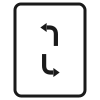
This sign is over the centre lane of a road. What does it mean?
A A. Drivers from both directions share it for left turnsB B. Drivers from both directions share it for passingC C. Only buses and carpools may drive in this laneD D. It is for left turns by your direction only
Question 27 of 50 Rules of the road
How do you do a two-point turn?
A A. Stop near the side, back into a driveway, then drive out the other wayB B. Turn sharply left mid-block, stop near the curb, then back up to the rightC C. Drive forward into a driveway, then back out into the far laneD D. Make a U-turn at a corner that has a traffic light
Question 28 of 50 Signs, signals and road markings
In B.C., what does a flashing green traffic light mean?
A A. Pedestrians control it; go only if the way is clearB B. Turn left only; through traffic has a red lightC C. The light will soon turn red; stop if you canD D. The signal is broken; treat it as a four-way stop
Question 29 of 50 Signs, signals and road markings
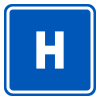
What does this sign tell you?
A A. A fire hall is nearbyB B. A pharmacy is nearbyC C. A rest area is nearbyD D. A hospital is nearby
Question 30 of 50 Speed and following distance
You spot a problem ahead. About how long does it take to see, think and press the brake before the car starts to slow?
A A. About half a secondB B. About three secondsC C. About one and a half secondsD D. About five seconds
Question 31 of 50 Safe driving and hazards
Which lights should you use when driving in fog, rain or snow?
A A. Low beam headlightsB B. High beam headlightsC C. Parking lights onlyD D. Daytime running lights only
Question 32 of 50 Sharing the road
The gate is down at a railway crossing. What must you do?
A A. Stop and wait for the gate to go upB B. Drive around it if no train is in sightC C. Stop, look both ways, then go around itD D. Slow down and cross if the tracks look clear
Question 33 of 50 Safe driving and hazards
In B.C., until when must a child ride in a booster seat?
A A. Age 6 or 120 cm tall, whichever comes firstB B. Age 9 or 145 cm tall, whichever comes firstC C. Age 12 or 160 cm tall, whichever comes firstD D. Age 8 or 135 cm tall, whichever comes first
Question 34 of 50 Alcohol, drugs and penalties
The label on your cold medicine says it may cause drowsiness. What is the safest choice?
A A. Drive with a window open for fresh airB B. Let someone else drive youC C. Drive only on quiet side streetsD D. Drive well below the speed limit
Question 35 of 50 Right-of-way
Another vehicle reaches a traffic circle at the same moment you do. Who should yield?
A A. You yield to the vehicle on your leftB B. The driver who plans to exit first yieldsC C. You yield to the vehicle on your rightD D. The larger vehicle yields to the smaller one
Question 36 of 50 Safe driving and hazards
Your car starts to hydroplane on a wet road. What should you do?
A A. Brake firmly until you feel the tires grip againB B. Speed up gently to push through the waterC C. Ease off the gas and keep driving straightD D. Steer quickly from side to side to find grip
Question 37 of 50 Sharing the road
In B.C., the speed limit is 60 km/h. You approach a tow truck stopped at the roadside with lights flashing. What is the fastest you may pass?
A A. 30 km/hB B. 40 km/hC C. 50 km/hD D. 60 km/h
Question 38 of 50 Signs, signals and road markings
In B.C., what do yellow lines on the road divide?
A A. Traffic moving in opposite directionsB B. Traffic moving the same wayC C. Bicycle lanes from car lanesD D. Parking spaces from traffic
Question 39 of 50 Licensing and insurance
What does ICBC's Basic Autoplan coverage make sure every B.C. motorist carries?
A A. Free repairs for any damage to their carB B. A free yearly safety check of their carC C. A minimum amount of liability insuranceD D. Cover for a rental car while on holiday
Question 40 of 50 Signs, signals and road markings
This sign has a speed tab below it. What does the tab tell you?
A A. The speed trains travel through the crossingB B. The safe speed is lower than the posted limitC C. The lowest speed allowed over the tracksD D. The new speed limit after the tracks
Question 41 of 50 Sharing the road
You are following a large truck. What tells you that you are out of the driver's blind spot behind it?
A A. You can read its licence plate clearlyB B. You are within one car length of itC C. You can see both of its side mirrorsD D. You can see its brake lights clearly
Question 42 of 50 Turning, passing and lanes
In ideal conditions, about how long does it take most stopped vehicles to turn left and reach 50 km/h?
A A. About two secondsB B. About five secondsC C. About seven secondsD D. About twelve seconds
Question 43 of 50 Signs, signals and road markings
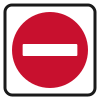
What does this sign mean?
A A. You may enter only to make a right turnB B. You may not enter this road from hereC C. You must yield before you enter this roadD D. This road is closed to large trucks only
Question 44 of 50 Safe driving and hazards
Your car has ABS. How should you brake in an emergency?
A A. Pump the pedal quickly until the car comes to a stopB B. Press lightly, then pump the pedal if the car skidsC C. Press hard, then ease off the pedal as the car slowsD D. Press hard and hold the pedal down until you stop
Question 45 of 50 Right-of-way
You have stopped at a steady red light and want to turn right. No sign forbids it. What may you do?
A A. Wait for the green light before turningB B. Turn right once the intersection is clearC C. Turn right only if a green arrow showsD D. Turn right only after the cross light turns yellow
Question 46 of 50 Parking and stopping
You are parked at the curb and about to open your door. What should you do first?
A A. Turn on your hazard lights and open it fastB B. Check your mirror and do a shoulder checkC C. Sound your horn to warn anyone nearbyD D. Open it a little and listen for traffic
Question 47 of 50 Signs, signals and road markings
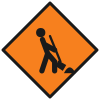
In B.C., a speed limit is posted in the work zone past this sign. When does that limit apply?
A A. Only when workers are presentB B. At all hours, day and nightC C. Only from dawn until duskD D. Only on weekdays during work
Question 48 of 50 Right-of-way
You face a steady red light and want to go straight ahead. What must you do?
A A. Stop fully, then go when the way is clearB B. Slow down and go if no cars are comingC C. Stop only if cross traffic is near youD D. Stop fully and wait for the light to turn green
Question 49 of 50 Rules of the road
In B.C., you must dim your high beams when you are within what distance of another vehicle?
A A. 50 metresB B. 100 metresC C. 150 metresD D. 300 metres
Question 50 of 50 Parking and stopping
When you park parallel to the curb, how close to the curb should your vehicle be?
A A. Within 50 centimetresB B. Within 75 centimetresC C. Within 100 centimetresD D. Within 30 centimetres
The timer starts when you answer the first question. Keyboard: A–D or 1–4 to answer, N next, P previous.