Question 1 of 65 Road signs
Small green signs with numbers along a highway are mile markers. How can they help you?
A A. They show the speed limit for the next mileB B. They mark the places where you may parkC C. They show how far it is to the next rest stopD D. They tell people where you are in an emergency
Question 2 of 65 Road signs
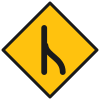
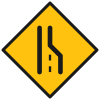
What does this sign warn you about?
A A. Your lane ends and you must stop at the endB B. The road splits into two roadsC C. Another lane of traffic will join yoursD D. Two-way traffic is ahead on this road
Question 3 of 65 Road signs
A white sign says "PASS WITH CARE". What does it mean?
A A. The no-passing zone has endedB B. You must pass any slow vehicle aheadC C. Passing is allowed only on the rightD D. A no-passing zone begins here
Question 4 of 65 Road signs
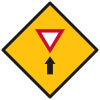
What does this sign warn you about?
A A. A yield sign is coming upB B. A stop sign is coming upC C. Your lane is about to endD D. A school zone starts soon
Question 5 of 65 Road signs
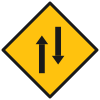
You are on a one-way street and see this sign. What does it mean?
A A. The road ahead is one-way the other wayB B. Two lanes merge into one lane aheadC C. Traffic will soon come toward you on this roadD D. You may now pass on either side of the car ahead
Question 6 of 65 Road signs
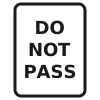
What does this sign mean?
A A. You may not pass other vehicles hereB B. You may pass only on the right side hereC C. Trucks may not use this roadD D. You may not stop on this stretch
Question 7 of 65 Road signs
A blue sign with a white "H" tells you:
A A. A hotel is nearbyB B. A helicopter pad is nearbyC C. A hospital is nearbyD D. A highway begins here
Question 8 of 65 Road signs
Most diamond-shaped signs:
A A. Tell you a law that you must obeyB B. Warn you of a hazard or change aheadC C. Show the way to a city or townD D. List services such as food and fuel
Question 9 of 65 Road signs
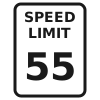
You pass this sign, but rain is falling hard and you cannot see well. What should you do?
A A. Drive at the posted speed, since it is legalB B. Drive a little faster to get out of the rainC C. Drive at the posted speed with hazard lights onD D. Drive slower than the posted speed
Question 10 of 65 Road signs
You are in the lane that this sign says will end. What should you do?
A A. Stop at the end of the lane and waitB B. Speed up and pass cars in the next laneC C. Signal and merge when there is a safe gapD D. Stay in it, since lanes like this reopen soon
Question 11 of 65 Road signs
A sign and a police officer at an intersection give you different orders. Whom do you obey?
A A. The signB B. Whichever is closer to youC C. The police officerD D. Whichever is more cautious
Question 12 of 65 Road signs
Why do stop and yield signs have shapes no other sign uses?
A A. So drivers can tell them apart even from behindB B. Because those shapes are cheaper to makeC C. So both signs can fit on the same poleD D. Because they are only used in big cities
Question 13 of 65 Road signs
A crossing has only this sign, with no lights or gates. What should you do?
A A. Cross at normal speed, since there is no signalB B. Stop only if a gate starts to come downC C. Sound your horn and cross as fast as you canD D. Look both ways and stop if a train is near
Question 14 of 65 Road signs
In Wisconsin, what does a county road sign look like?
A A. A white rectangle with rounded edgesB B. A yellow diamond with black lettersC C. A green circle with white lettersD D. A brown square with a white park symbol
Question 15 of 65 Road signs
A sign says "SLOWER TRAFFIC KEEP RIGHT". What does it mean?
A A. Trucks must always use the left laneB B. Slower drivers should use the right laneC C. The right lane is only for cars leaving the roadD D. You must pass slower cars on the right
Question 16 of 65 Rules of the road · Parking and stopping
How should you start to parallel park?
A A. Pull up beside the car in front of the spaceB B. Back straight into the space from behind itC C. Drive in nose first and then straighten outD D. Stop behind the space and wait for a gap
Question 17 of 65 Rules of the road · Speed and following distance
When you are stopped behind another car, how much space should you leave?
A A. Enough to see its rear tires touch the roadB B. About one foot, so no one can cut inC C. None; pull right up to its bumperD D. Enough room to fit two more cars
Question 18 of 65 Rules of the road · Right of way
At a four-way stop, you and an oncoming car stop at the same time. You want to turn left; they are going straight. Who goes first?
A A. You do, since you are turningB B. The car going straightC C. Whoever has the larger carD D. Neither; wait for another car
Question 19 of 65 Rules of the road · Right of way
You are at a stop sign. The cross street has no stop sign. When may you go?
A A. After stopping, when there is a safe gapB B. Right away, since you stoppedC C. When cross traffic stops to let you inD D. When you flash your lights at them
Question 20 of 65 Rules of the road · Parking and stopping
When you finish parallel parking, where should your car be?
A A. At an angle, with the back sticking outB B. Close to and lined up with the curbC C. Touching the bumper of the car behindD D. With two wheels up on the sidewalk
Question 21 of 65 Rules of the road · Alcohol, drugs and penalties
Some cold medicines warn they may cause drowsiness. What does this mean for driving?
A A. They have no effect on drivingB B. They help you stay alertC C. They can make driving unsafeD D. They are only a problem at night
Question 22 of 65 Rules of the road · Alcohol, drugs and penalties
In Wisconsin, how long is a habitual traffic offender's driving privilege revoked?
A A. Five yearsB B. Three yearsC C. Four yearsD D. Seven years
Question 23 of 65 Rules of the road · Turning, passing and lanes
What is a blind spot?
A A. A dark spot on the road at nightB B. A spot near a corner where you must not parkC C. A stretch of road with no streetlightsD D. An area near your car your mirrors do not show
Question 24 of 65 Rules of the road · Parking and stopping
When you finish parallel parking in Wisconsin, about how far from the curb should your car be?
A A. About 4 inchesB B. About 4 feetC C. About 5 feetD D. About a foot
Question 25 of 65 Rules of the road · Speed and following distance
Can you get a ticket for driving at the posted limit?
A A. No, the posted limit is always legalB B. Only on highways with a minimum speedC C. Yes, if that speed is unsafe for conditionsD D. Only at night, when visibility is low
Question 26 of 65 Rules of the road · Right of way
A person with a white cane or a guide dog is at a crossing. What should you do?
A A. Honk to let them know you are thereB B. Drive past slowlyC C. Wave them acrossD D. Stop and let them cross
Question 27 of 65 Rules of the road · Speed and following distance
If you double your speed, about how much farther do you travel once you brake?
A A. About four times as farB B. About the same distanceC C. About twice as farD D. About half as far
Question 28 of 65 Rules of the road · Right of way
In Wisconsin, a school bus is stopped with red lights flashing. How far from it must you stop?
A A. At least 8 feetB B. At least 12 feetC C. At least 20 feetD D. At least 50 feet
Question 29 of 65 Rules of the road · Right of way
You are leaving an alley and must cross a sidewalk. What should you do?
A A. Drive across slowly without stoppingB B. Stop only once you reach the streetC C. Stop before the sidewalk and yield to peopleD D. Honk to warn people, then drive on
Question 30 of 65 Rules of the road · Speed and following distance
Why should you drive slower on a gravel road?
A A. Gravel gives less grip for stopping and turningB B. Gravel roads are usually one-wayC C. Gravel can make your engine run too hotD D. Gravel roads have no posted speed limit
Question 31 of 65 Rules of the road · Safe driving and hazards
How far should you sit from the airbag in the steering wheel?
A A. About 2 inchesB B. About 5 inchesC C. It does not matterD D. At least 10 inches
Question 32 of 65 Rules of the road · Turning, passing and lanes
In what order should you change lanes?
A A. Move over first, then signal and checkB B. Check your mirrors, move over, then signalC C. Signal, check mirrors and blind spot, then moveD D. Signal and move over at the same time
Question 33 of 65 Rules of the road · Right of way
In general, how should you treat a funeral procession?
A A. Pass through any gaps in the lineB B. Yield and do not cut into the lineC C. Join the end of the line to follow itD D. Honk to make it move faster
Question 34 of 65 Rules of the road · Signals and pavement markings
A center lane is marked with a solid yellow line and a broken yellow line on each side. What is it for?
A A. Passing slow traffic on a two-lane roadB B. Buses, taxis and carpools onlyC C. Left turns by traffic from both directionsD D. Parking for short stops and deliveries
Question 35 of 65 Rules of the road · Right of way
You are in the middle of an intersection when an ambulance with a siren comes up behind you. What should you do?
A A. Stop right away in the intersectionB B. Back up out of the intersectionC C. Clear the intersection, then pull overD D. Turn left in front of it to get away
Question 36 of 65 Rules of the road · Speed and following distance
In Wisconsin, what is the top speed in outlying parts of cities and villages that have no posted limit?
A A. 30 mphB B. 35 mphC C. 40 mphD D. 45 mph
Question 37 of 65 Rules of the road · Signals and pavement markings
What must you do at a steady red traffic light?
A A. Slow down and go if the road is clearB B. Stop only if cars are crossingC C. Go if you are turning leftD D. Stop and wait behind the stop line
Question 38 of 65 Rules of the road · Sharing the road
When may a cyclist ride in the middle of a traffic lane?
A A. Never; cyclists must stay at the edgeB B. Only on highways and freewaysC C. When the lane is too narrow to share safelyD D. Only at night with lights on
Question 39 of 65 Rules of the road · Right of way
You are coming up to a roundabout and someone is waiting at the crosswalk before it. What should you do?
A A. Enter, since the roundabout comes firstB B. Speed up to clear the crosswalkC C. Stop and let them cross before enteringD D. Honk and then enter
Question 40 of 65 Rules of the road · Safe driving and hazards
The headlights of an oncoming car are blinding you. Where should you look?
A A. Straight into the oncoming lightsB B. Toward the right edge of your laneC C. At the center line next to the carD D. Down at your dashboard until it passes
Question 41 of 65 Rules of the road · Safe driving and hazards
What is an "escape route" when driving?
A A. Open space you can steer intoB B. A quick road out of the cityC C. An exit ramp off a highwayD D. A lane for emergency vehicles
Question 42 of 65 Rules of the road · Emergencies and equipment
A front tire blows out. What should you do?
A A. Brake hard right away to stop fastB B. Hold the wheel firmly and ease off the gasC C. Turn the wheel sharply to the shoulderD D. Speed up to keep control of the car
Question 43 of 65 Rules of the road · Alcohol, drugs and penalties
A Wisconsin occupational license lets you drive up to how many hours a week?
A A. 24 hoursB B. 36 hoursC C. 60 hoursD D. 84 hours
Question 44 of 65 Rules of the road · Alcohol, drugs and penalties
What does "implied consent" mean?
A A. You agree to let police search your homeB B. You may refuse any test with no penaltyC C. By driving, you agree to alcohol or drug testsD D. Your passengers also agree to be tested
Question 45 of 65 Rules of the road · Right of way
A car is already in the intersection when you arrive. What should you do?
A A. Pull out in front of itB B. Flash your lightsC C. Go if it is to your leftD D. Let it go through first
Question 46 of 65 Rules of the road · Right of way
Which statement about the right-of-way is true?
A A. No driver should insist on taking itB B. The faster car always has the right-of-wayC C. You can take it if you honk firstD D. It always goes to the larger vehicle
Question 47 of 65 Rules of the road · Speed and following distance
When should you leave more space between you and the car ahead?
A A. Only on dry, sunny daysB B. Only when driving in citiesC C. Only when the car ahead is smallD D. In rain, fog, or at night
Question 48 of 65 Rules of the road · Parking and stopping
Which way should your car face when you park on a two-way street?
A A. Against the flow of traffic on that sideB B. Either way, as long as you are near the curbC C. At an angle to the curbD D. The same way as traffic on that side
Question 49 of 65 Rules of the road · Safe driving and hazards
You see children playing near the road ahead. What is a good step to take?
A A. Speed up to get past them before they moveB B. Honk the whole timeC C. Move to the center lineD D. Cover the brake so you can stop fast
Question 50 of 65 Rules of the road · Parking and stopping
In Wisconsin, where should your front wheels stop at a crosswalk marked with a solid white stop line?
A A. Just before the solid white lineB B. On the crosswalk itselfC C. Past the first lane lineD D. Halfway into the crossing
Question 51 of 65 Rules of the road · Emergencies and equipment
Your headlights suddenly go out at night. What should you do?
A A. Keep driving slowly in the darkB B. Stop right where you are in the laneC C. Follow the lights of the car ahead closelyD D. Turn on hazards and pull off the road
Question 52 of 65 Rules of the road · Right of way
You are in a roundabout and an emergency vehicle with a siren comes up. What should you do?
A A. Stop right where you are in the roundaboutB B. Leave at the next exit, then pull overC C. Keep circling until it is goneD D. Speed up and stay in front of it
Question 53 of 65 Rules of the road · Emergencies and equipment
You see smoke coming from under the hood. What should you do?
A A. Pull over, get out, and move awayB B. Open the hood right away to lookC C. Keep driving to the next garageD D. Pour water on the engine at once
Question 54 of 65 Rules of the road · Speed and following distance
In Wisconsin, how should you change your following gap in rain, snow or heavy traffic?
A A. Add one car length for each 10 mphB B. Keep the same gap and just slow downC C. Add a second for each bad conditionD D. Close the gap so no one cuts in
Question 55 of 65 Rules of the road · Parking and stopping
A police car signals you to pull over. What should you do?
A A. Stop in your lane right awayB B. Get out and walk back to the officerC C. Pull to the right and stay in the carD D. Keep going to the next exit first
Question 56 of 65 Rules of the road · Right of way
A Wisconsin funeral procession reaches a traffic light. Which vehicle in the line must obey the signal?
A A. Only the last car in the lineB B. The first vehicle in the lineC C. None of the cars in the lineD D. Only cars without their headlights on
Question 57 of 65 Rules of the road · Speed and following distance
What is the "basic speed rule"?
A A. Never drive faster than is safe for conditionsB B. Always drive at exactly the posted limitC C. Drive at the same speed as the car aheadD D. Drive as fast as the road and your car allow
Question 58 of 65 Rules of the road · Emergencies and equipment
Your car breaks down on the highway. What should you do?
A A. Stop in the lane and fix it thereB B. Walk along the lanes to find helpC C. Leave it running in the lane and waitD D. Pull off the road and turn on hazards
Question 59 of 65 Rules of the road · Turning, passing and lanes
On a highway with several lanes, what is the left lane mainly for?
A A. Slow trucksB B. ParkingC C. StoppingD D. Passing
Question 60 of 65 Rules of the road · Safe driving and hazards
Where should you look while you drive?
A A. Only at the car right in frontB B. Mostly at your speed on the dashboardC C. Only at the side of the roadD D. Far ahead and all around you
Question 61 of 65 Rules of the road · Turning, passing and lanes
When joining a highway, what should you look for?
A A. The car with the loudest hornB B. A place to stop and wait on the rampC C. A gap in traffic to merge intoD D. An empty left lane
Question 62 of 65 Rules of the road · Emergencies and equipment
Your brakes suddenly stop working. What should you do first?
A A. Turn off the engine and take out the keyB B. Shift into neutral and coast to a stopC C. Pump the brakes and shift to a lower gearD D. Open your door to look at the brakes
Question 63 of 65 Rules of the road · Speed and following distance
Why is following distance measured in seconds instead of feet?
A A. Feet are only used for trucksB B. Seconds stay right at any speedC C. Seconds are shorter than feetD D. Feet change with the weather
Question 64 of 65 Rules of the road · Speed and following distance
School zone lights are flashing and children are near. What should you do?
A A. Keep your normal speed through the zoneB B. Speed up so you clear the zone soonerC C. Stop and wait for the lights to stop flashingD D. Slow to the school limit and watch for children
Question 65 of 65 Rules of the road · Right of way
Two lanes merge into one. What is the best way to handle it?
A A. Speed up so no one can get in aheadB B. Stop until the other lane is emptyC C. Use the shoulder to get ahead of the lineD D. Take turns and let one car in at a time
Answer each question to see the explanation. Keyboard: A–D or 1–4 to answer, N next, P previous.