Question 1 of 25 Sharing the road
After passing a large truck, when should you move back in front of it?
A A. When its whole front shows in your mirrorB B. Right after you pass the truck's cabC C. As soon as you are beside its frontD D. When the truck driver flashes lights
Question 2 of 25 Right of way
You are turning left into a driveway across the oncoming lane. Who must you yield to?
A A. Only the cars that are behind youB B. No one, since you have signaledC C. Oncoming traffic and people on the sidewalkD D. Only large trucks coming toward you
Question 3 of 25 Right of way (West Virginia)
You are merging onto a West Virginia interstate from the entrance ramp. Who has the right of way?
A A. You, since you are enteringB B. Whoever is going fasterC C. The larger of the two vehiclesD D. Traffic already on the interstate
Question 4 of 25 Road signs
You come to this sign. There is no stop line and no crosswalk. Where should you stop?
A A. In the middle of the intersection, so you can see both waysB B. Before you enter the intersection, where you can seeC C. Next to the sign post, even if you cannot seeD D. Nowhere; with no line you only need to slow down
Question 5 of 25 Alcohol, drugs and penalties
What happens when you mix alcohol with other drugs?
A A. The effects cancel each other outB B. The alcohol wears off much fasterC C. Nothing changes at allD D. The effects can be much stronger
Question 6 of 25 Speed and following distance (West Virginia)
Unless another limit is posted, what is the speed limit in West Virginia business or residential areas?
A A. 18 mphB B. 25 mphC C. 40 mphD D. 45 mph
Question 7 of 25 Sharing the road
How should you pass a person riding a horse?
A A. Quickly, with a short honk to warn themB B. Slowly, with plenty of room and no hornC C. Close by, so you get past soonerD D. With your high beams on so they see you
Question 8 of 25 Road signs
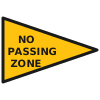
This pennant-shaped sign is on the left side of the road. What does it mark?
A A. A sharp curve to the left aheadB B. A lane that ends on the leftC C. The start of a no-passing zoneD D. A road that splits in two ahead
Question 9 of 25 Licensing and insurance (West Virginia)
During the first six months, which passengers may a West Virginia Level 2 driver not carry?
A A. Family members under 16B B. Non-family passengers under 20C C. Any adult passengers over 21D D. Passengers in the back seat
Question 10 of 25 Turning, passing and lanes (West Virginia)
You reach the end of a West Virginia interstate acceleration lane and still find no gap. What does the handbook allow as a last resort?
A A. Drive onto the shoulder past the lane and stopB B. Stop at the end of the ramp itselfC C. Back up the ramp to try againD D. Cut quickly into the nearest lane
Question 11 of 25 Turning, passing and lanes
Where is a U-turn most likely to be unsafe or not allowed?
A A. On a quiet street with a clear view both waysB B. At a light that has a U-turn arrowC C. Near a curve or hill where others cannot see youD D. On a wide road with no traffic in sight
Question 12 of 25 Parking and stopping
Your car is parked on a downhill slope beside a curb. How should the front wheels point?
A A. Away from the curbB B. Straight aheadC C. Toward the middle of the roadD D. Toward the curb
Question 13 of 25 Road signs
A stop sign has a small plaque below it that says "ALL WAY". What does this mean?
A A. Traffic from every direction must stopB B. Only you must stop; others may keep goingC C. You may turn any way you likeD D. The stop sign is only for trucks
Question 14 of 25 Speed and following distance
When is the best time to slow down for a curve?
A A. In the middle of the curveB B. Before you enter the curveC C. As you leave the curveD D. Only if you start to skid
Question 15 of 25 Right of way
You are at a stop sign and want to turn left. Cross traffic does not stop. What do you need before you go?
A A. A gap in traffic from the left onlyB B. A safe gap in traffic from both waysC C. A gap in traffic from the right onlyD D. A wave from another driver
Question 16 of 25 Parking and stopping
May you park so that you block a driveway?
A A. No, it is not allowedB B. Yes, for a short timeC C. Yes, if you leave a noteD D. Yes, if no one is home
Question 17 of 25 Road signs
A sign says "SOFT SHOULDER". What should you do?
A A. Avoid driving on the edge of the roadB B. Use the shoulder to pass slow carsC C. Park on the shoulder if you need to stopD D. Drive on the shoulder when it rains
Question 18 of 25 Alcohol, drugs and penalties
In nearly every state, what is the legal blood alcohol limit for drivers 21 and over?
A A. 0.08 percentB B. 0.10 percentC C. 0.15 percentD D. 0.20 percent
Question 19 of 25 Road signs
A crossing has only this sign, with no lights or gates. What should you do?
A A. Cross at normal speed, since there is no signalB B. Stop only if a gate starts to come downC C. Sound your horn and cross as fast as you canD D. Look both ways and stop if a train is near
Question 20 of 25 Sharing the road
When are cyclists hardest for drivers to see?
A A. At dusk, at night, and in bad weatherB B. At noon on a clear, dry dayC C. When they ride in a bike laneD D. When they wear bright clothes
Question 21 of 25 Safe driving and hazards
Why is texting while driving so dangerous?
A A. It drains your phone battery fasterB B. It is only dangerous when driving at nightC C. It is only a problem on busy highwaysD D. It takes your eyes and mind off the road
Question 22 of 25 Emergencies and equipment (West Virginia)
In West Virginia, a child under 8 may use a seat belt instead of a child safety seat once the child is how tall?
A A. At least 4 feet 2 inchesB B. At least 4 feet 5 inchesC C. At least 4 feet 11 inchesD D. At least 4 feet 9 inches
Question 23 of 25 Alcohol, drugs and penalties (West Virginia)
According to the West Virginia handbook, a BAC above what level, but below 0.08 percent, is evidence that a driver may be impaired?
A A. 0.01 percentB B. 0.03 percentC C. 0.04 percentD D. 0.05 percent
Question 24 of 25 Alcohol, drugs and penalties
Your doctor gives you a new medicine. What should you do before driving?
A A. Drive as usual, since it was prescribedB B. Take more to make it work fasterC C. Drink coffee to cancel any side effectsD D. Read the label and ask if it affects driving
Question 25 of 25 Speed and following distance
When you are stopped behind another car, how much space should you leave?
A A. Enough to see its rear tires touch the roadB B. About one foot, so no one can cut inC C. None; pull right up to its bumperD D. Enough room to fit two more cars
Answer each question to see the explanation. Keyboard: A–D or 1–4 to answer, N next, P previous.