Question 1 of 50 Alcohol, drugs and penalties
A medicine label says "Do not operate heavy machinery." What should you do?
A A. Drive as normal; cars are not machineryB B. Drive only on quiet roads or highwaysC C. Drive with the windows open to stay alertD D. Do not drive until you know how it affects you
Question 2 of 50 Sharing the road
You want to pass a cyclist on a narrow road with oncoming cars. What should you do?
A A. Wait behind until you can pass safelyB B. Squeeze by between the bike and carsC C. Honk to make the rider move overD D. Pass on the right side instead
Question 3 of 50 Road signs
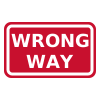
You see this sign facing you. What does it mean?
A A. You are driving against trafficB B. You took a wrong turn but may keep goingC C. The road ahead has a sharp curveD D. You are on a road that has no exit
Question 4 of 50 Alcohol, drugs and penalties
Which ability does alcohol usually affect first?
A A. HearingB B. Sense of smellC C. Muscle strengthD D. Judgment
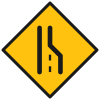
Question 5 of 50 Road signs
What does this sign mean?
A A. The road gets narrow on both sidesB B. Two roads join into one roadC C. A right turn is coming upD D. The right lane ends ahead
Question 6 of 50 Sharing the road
Why is it dangerous to cut in front of a large truck?
A A. It cannot turn left at lightsB B. Its brakes do not work well in rainC C. It needs much more distance to stopD D. It is almost always speeding
Question 7 of 50 Right of way
Your light turns green, but an ambulance with flashing lights and a siren is coming. What should you do?
A A. Stay stopped and let it go byB B. Go, since you have the green lightC C. Turn right to get out of the wayD D. Speed up to clear the intersection
Question 8 of 50 Turning, passing and lanes
At an intersection with two left-turn lanes, how should you turn?
A A. Move to the other turn lane in the turnB B. Turn into any lane that is openC C. Stay in your own lane through the turnD D. Use the inside lane only, then move
Question 9 of 50 Road signs
A small yellow sign below a curve sign shows "35 MPH". What does it mean?
A A. The new legal limit for the rest of the roadB B. A safe speed for the curve in good conditionsC C. The lowest speed allowed in the curveD D. The speed limit for trucks and buses only
Question 10 of 50 Turning, passing and lanes
How should you signal when leaving a roundabout?
A A. Signal left the whole way roundB B. Signal right before your exitC C. Do not signal in a roundaboutD D. Use your hazards
Question 11 of 50 Right of way
A car is already in the intersection when you arrive. What should you do?
A A. Pull out in front of itB B. Flash your lightsC C. Go if it is to your leftD D. Let it go through first
Question 12 of 50 Road signs
A speed sign on a highway shows "MINIMUM 40". What does it mean?
A A. You must drive at least 40 even in heavy snowB B. Trucks must not go faster than 40C C. You should not drive below 40 in good conditionsD D. 40 is the speed limit for all drivers at night
Question 13 of 50 Signals and pavement markings
What does a steady green light mean?
A A. Go at once, since green means you have the roadB B. Stop first and then go when it is clearC C. Go if the way is clear, yielding as neededD D. Only turns are allowed until the light changes
Question 14 of 50 Alcohol, drugs and penalties
What can happen if you get many traffic tickets in a short time?
A A. You get a safe-driving rewardB B. Your license lasts longerC C. Your license can be suspendedD D. Your insurance goes down
Question 15 of 50 Safe driving and hazards
Rain is so heavy you cannot see the road. What should you do?
A A. Keep going at the same speedB B. Turn on your high beams to see betterC C. Pull off the road safely and waitD D. Follow the car ahead closely
Question 16 of 50 Safe driving and hazards
How can you let other drivers know what you plan to do?
A A. Change lanes first, then signalB B. Speed up as you near intersectionsC C. Flash your high beams at every carD D. Use your signals and brake lights
Question 17 of 50 Emergencies and equipment
When should you use your hazard warning lights?
A A. When parking in a no-parking zoneB B. When your stopped car could be a hazardC C. When driving in light rain or mistD D. When you are late and driving fast
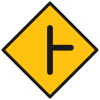
Question 18 of 50 Road signs
What should you expect after you pass this sign?
A A. Cars may enter from a road on the rightB B. Your road ends and you must turn rightC C. The right lane is closed aheadD D. The road bends sharply to the right
Question 19 of 50 Alcohol, drugs and penalties
You are in a crash. Is it legal to drive away without stopping?
A A. Yes, if no one is hurtB B. Yes, if it was not your faultC C. Yes, if the damage is smallD D. No, you must stop
Question 20 of 50 Speed and following distance
Why should you avoid driving right beside other cars on a multi-lane road?
A A. You may be in their blind spot and boxed inB B. It is against the law on most roadsC C. It uses more fuel than driving aloneD D. It makes your headlights glare at them
Question 21 of 50 Safe driving and hazards
Why is driving at night riskier than in the day?
A A. Roads are busier at night than by dayB B. You cannot see as far or as clearlyC C. Speed limits are higher at nightD D. Cars run worse when it is cold
Question 22 of 50 Speed and following distance (Utah)
How does Utah mark the zones where a rural interstate speed limit changes?
A A. With pavement markings and extra signsB B. With flashing yellow lights onlyC C. With orange cones set along the right shoulderD D. With rumble strips across the road
Question 23 of 50 Alcohol, drugs and penalties (Utah)
A Utah driver age 21 or older refuses a chemical test after a DUI arrest. How long is the license revoked for a first refusal?
A A. 9 monthsB B. 18 monthsC C. 30 monthsD D. 48 months
Question 24 of 50 Signals and pavement markings
What do two solid yellow lines down the center of the road mean?
A A. Passing is allowed from both sidesB B. The lane is for turning left onlyC C. The road is one-wayD D. No passing from either side
Question 25 of 50 Road signs
A sign in bright yellow-green is most likely to warn of:
A A. A sharp curve on a fast roadB B. A road closed for repairs aheadC C. A steep hill that trucks must avoidD D. A school, people walking, or bikes
Question 26 of 50 Signals and pavement markings (Utah)
In Utah, where may you move into or out of an I-15 express lane?
A A. Anywhere you can safely cross the linesB B. Only where a double white line is paintedC C. At any exit, as long as you signalD D. Only at access points with white dotted lines
Question 27 of 50 Right of way
When must you yield the right-of-way?
A A. Whenever it helps prevent a crashB B. Only when a sign tells you toC C. Only to police cars and fire trucksD D. Never, if you have a green light
Question 28 of 50 Right of way (Utah)
You stopped behind a Utah school bus with flashing red lights. When may you go?
A A. When the children have left the roadB B. After waiting about one full minuteC C. When the bus driver waves at youD D. When its flashing red lights stop
Question 29 of 50 Safe driving and hazards (Utah)
In Utah, children age 8 and under must use a child safety seat unless they are at least how tall?
A A. 50 inchesB B. 54 inchesC C. 57 inchesD D. 62 inches
Question 30 of 50 Turning, passing and lanes (Utah)
In Utah, you may not make a U-turn on a curve near a hilltop if you cannot see or be seen from how far?
A A. 250 feetB B. 500 feetC C. 800 feetD D. 1,200 feet
Question 31 of 50 Parking and stopping
Where is parking never allowed?
A A. On a quiet side streetB B. In an intersectionC C. In a marked spaceD D. In a parking lot
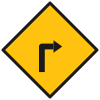
Question 32 of 50 Road signs
What does this sign warn of?
A A. A sharp right turn that needs a low speedB B. A gentle bend to the right that needs no slowingC C. A lane that is for right turns onlyD D. A detour that goes off to the right
Question 33 of 50 Parking and stopping (Utah)
In Utah, how close to a fire hydrant may you park?
A A. No closer than 15 feetB B. No closer than 5 feetC C. No closer than 10 feetD D. No closer than 25 feet
Question 34 of 50 Sharing the road
Where should you take extra care to watch for children?
A A. On highways and freewaysB B. In tunnels and on bridgesC C. Near schools, parks, and playgroundsD D. Near truck stops and rest areas
Question 35 of 50 Parking and stopping
Why is it unsafe to stop or park on railroad tracks?
A A. A train could hit your carB B. It can damage your tiresC C. It is only unsafe at nightD D. It blocks people walking
Question 36 of 50 Parking and stopping (Utah)
When may you use a runaway vehicle ramp in Utah?
A A. Only in an emergency, to stop your vehicleB B. To pull over and restC C. To turn around on a steep gradeD D. To park while you check your brakes
Question 37 of 50 Speed and following distance (Utah)
You are in the left lane of a Utah multi-lane highway and a car comes up behind you. What must you do?
A A. Keep your speed, since you are at the limitB B. Speed up to stay ahead of the carC C. Move right safely to let it passD D. Tap your brakes to warn the driver
Question 38 of 50 Right of way (Utah)
In Utah, a person with a white cane is crossing the street. What must you do?
A A. Honk so they know you are thereB B. Come to a complete stopC C. Drive around them with careD D. Wait only if they have a guide dog
Question 39 of 50 Alcohol, drugs and penalties
Which factor can raise a person's blood alcohol level?
A A. Drinking slowly with a mealB B. Drinking quickly on an empty stomachC C. Drinking water between each drinkD D. Waiting a few hours before driving
Question 40 of 50 Parking and stopping
May you park in a marked bike lane?
A A. Yes, for a short stop of a few minutesB B. Generally no, since it blocks cyclistsC C. Yes, if no bikes are coming at the timeD D. Yes, at night when few people ride
Question 41 of 50 Emergencies and equipment (Utah)
A Utah crash damages only property, and no one is hurt. What may the drivers do?
A A. Leave the scene once they swap namesB B. Wait in the lanes until police arriveC C. Leave the cars and walk awayD D. Move the cars out of the travel lanes
Question 42 of 50 Safe driving and hazards
Which headlights should you use in fog?
A A. High beamsB B. Parking lights onlyC C. Low beamsD D. No lights
Question 43 of 50 Turning, passing and lanes
A long line of cars is behind you on a two-lane road. What should you do?
A A. Speed up past the limit to keep upB B. Pull over where safe and let them passC C. Brake now and then to slow them downD D. Keep going at your speed and ignore them
Question 44 of 50 Safe driving and hazards
Why is texting while driving so dangerous?
A A. It drains your phone battery fasterB B. It is only dangerous when driving at nightC C. It is only a problem on busy highwaysD D. It takes your eyes and mind off the road
Question 45 of 50 Emergencies and equipment
Your car stalls on the railroad tracks and a train is coming. What should you do?
A A. Get out and walk away at an angle toward the trainB B. Stay in the car and try to restart itC C. Get out and stand close by to wave it downD D. Run straight down the tracks away from it
Question 46 of 50 Signals and pavement markings
What must you do at a steady red traffic light?
A A. Slow down and go if the road is clearB B. Stop only if cars are crossingC C. Go if you are turning leftD D. Stop and wait behind the stop line
Question 47 of 50 Safe driving and hazards
The headlights of an oncoming car are blinding you. Where should you look?
A A. Straight into the oncoming lightsB B. Toward the right edge of your laneC C. At the center line next to the carD D. Down at your dashboard until it passes
Question 48 of 50 Alcohol, drugs and penalties (Utah)
A Utah driver under 21 drives with any measurable alcohol. On a first offense, what happens to driving privileges?
A A. Denied for 6 monthsB B. Denied for 30 daysC C. Denied for 14 monthsD D. Denied for 4 years
Question 49 of 50 Signals and pavement markings (Utah)
According to the Utah handbook, when may a car drive in a marked bike lane?
A A. When passing slow cars on the rightB B. When waiting out a traffic jamC C. When parking for a few minutesD D. When entering or leaving an alley or driveway
Question 50 of 50 Road signs
Signs that are wider than they are tall, in green, usually:
A A. Tell you a rule you must obeyB B. Give directions and distancesC C. Warn of road workD D. Mark a school zone
Answer each question to see the explanation. Keyboard: A–D or 1–4 to answer, N next, P previous.