Question 1 of 25 Signals and pavement markings
There is a solid yellow line on your side of the center and a broken yellow line on the far side. May you pass?
A A. Yes, whenever the road ahead looks clearB B. Yes, but only if you are passing a truckC C. No; only oncoming drivers may pass hereD D. No; no one may pass from either side
Question 2 of 25 Road signs
Yellow signs with black symbols are used to:
A A. Show a rule about parkingB B. Warn you about the road aheadC C. Point out places to visitD D. Mark the end of a work zone
Question 3 of 25 Speed and following distance
Total stopping distance is made up of:
A A. Reaction distance plus braking distanceB B. The braking distance and nothing elseC C. Your car's length plus one car lengthD D. The gap between you and the car ahead
Question 4 of 25 Alcohol, drugs and penalties (South Dakota)
In South Dakota, what type of crime is a third DWI offense?
A A. A Class 1 misdemeanorB B. A Class 6 felonyC C. A Class 3 felonyD D. A Class 4 misdemeanor
Question 5 of 25 Road signs
A stop sign has a small plaque below it that says "ALL WAY". What does this mean?
A A. Traffic from every direction must stopB B. Only you must stop; others may keep goingC C. You may turn any way you likeD D. The stop sign is only for trucks
Question 6 of 25 Emergencies and equipment
Your hood flies up while you are driving. What should you do?
A A. Brake hard right there in the laneB B. Look through the gap and pull overC C. Stop and get out to close it in the laneD D. Keep driving until you get home
Question 7 of 25 Speed and following distance (South Dakota)
You drive through a South Dakota work zone, but no workers are present. What should you do?
A A. Drive at the normal posted limitB B. Speed up to get through it fastC C. Slow down only if you see workersD D. Still reduce your speed
Question 8 of 25 Road signs
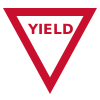
What does this sign tell you to do?
A A. Let traffic with the right-of-way go firstB B. Stop every time, even when the road is emptyC C. Speed up to merge ahead of other trafficD D. Keep going, since others must yield to you
Question 9 of 25 Turning, passing and lanes
At an intersection with two left-turn lanes, how should you turn?
A A. Move to the other turn lane in the turnB B. Turn into any lane that is openC C. Stay in your own lane through the turnD D. Use the inside lane only, then move
Question 10 of 25 Right of way
Another car is passing you on a two-lane road. What should you do?
A A. Speed up so it cannot passB B. Move toward the center lineC C. Brake hard to let it back inD D. Stay right and do not speed up
Question 11 of 25 Safe driving and hazards
You feel very sleepy while driving. What should you do?
A A. Open the window and keep goingB B. Stop in a safe place and restC C. Turn up the radioD D. Drive faster to get home sooner
Question 12 of 25 Turning, passing and lanes (South Dakota)
Where does the South Dakota manual say you may not make a U-turn?
A A. Mid-block on a street in a business districtB B. At a legal opening on a divided highwayC C. Where an officer directs you to make oneD D. On a wide rural road with clear views
Question 13 of 25 Parking and stopping
In many states, what does a curb painted red mean?
A A. Parking for 20 minutesB B. No stopping or parkingC C. Loading onlyD D. Parking for disabled drivers
Question 14 of 25 Turning, passing and lanes
On which side should you normally pass another vehicle?
A A. On the rightB B. On the shoulderC C. Either sideD D. On the left
Question 15 of 25 Signals and pavement markings
What does a flashing yellow light mean?
A A. Stop and wait for a green lightB B. Slow down and go on with careC C. The light is about to turn redD D. The road ahead is closed
Question 16 of 25 Safe driving and hazards
Your car starts to hydroplane on a wet road. What should you do?
A A. Ease off the gas and keep the wheel straightB B. Brake hard until the car stopsC C. Speed up to push through the waterD D. Turn the wheel sharply to the side
Question 17 of 25 Turning, passing and lanes
How should you turn left from a one-way street onto another one-way street?
A A. From the right lane into the right laneB B. From the far left lane into the far left laneC C. From the left lane into the right laneD D. From any lane into whatever lane is open
Question 18 of 25 Right of way
You and a driver on your right stop at a four-way stop at the same time. Who goes first?
A A. You doB B. The driver on your rightC C. Whoever is going straightD D. Whoever honks first
Question 19 of 25 Right of way
You are in a roundabout and an emergency vehicle with a siren comes up. What should you do?
A A. Stop right where you are in the roundaboutB B. Leave at the next exit, then pull overC C. Keep circling until it is goneD D. Speed up and stay in front of it
Question 20 of 25 Sharing the road
Why is it dangerous to cut in front of a large truck?
A A. It cannot turn left at lightsB B. Its brakes do not work well in rainC C. It needs much more distance to stopD D. It is almost always speeding
Question 21 of 25 Right of way (South Dakota)
You reach a single-lane bridge on a rural South Dakota road. Who generally has the right-of-way?
A A. The first driver to reach the bridgeB B. The driver going fasterC C. The larger vehicleD D. The driver who is coming from the right side
Question 22 of 25 Turning, passing and lanes (South Dakota)
According to the South Dakota manual, about how long does it take to pass another car at 55 mph?
A A. About 3 secondsB B. About 10 secondsC C. About 6 secondsD D. About 40 seconds
Question 23 of 25 Road signs (South Dakota)
According to the South Dakota manual, when is a "THINK" sign by the road taken down right away?
A A. When the road gets a new speed limitB B. After it has stood through one winterC C. When a driver on that road complainsD D. When a close family member of the victim objects
Question 24 of 25 Sharing the road
What are the "no zones" around a large truck?
A A. Lanes where trucks are not allowed to driveB B. Areas where trucks may not park overnightC C. Places where cars may not pass a truckD D. Blind spots where the driver cannot see you
Question 25 of 25 Signals and pavement markings
A broken yellow line is on your side of the center. What does it mean?
A A. You may never pass hereB B. You may pass only on the rightC C. The lane is for turning onlyD D. You may pass when it is safe
Answer each question to see the explanation. Keyboard: A–D or 1–4 to answer, N next, P previous.