Question 1 of 25 Sharing the road
Why should you stay well back from a snowplow?
A A. It always drives faster than carsB B. It throws snow and may stop suddenlyC C. It has no lights or signalsD D. It must yield to all other cars
Question 2 of 25 Safe driving and hazards
How can you let other drivers know what you plan to do?
A A. Change lanes first, then signalB B. Speed up as you near intersectionsC C. Flash your high beams at every carD D. Use your signals and brake lights
Question 3 of 25 Road signs
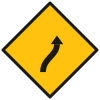
What does this sign warn you about?
A A. You must turn right at the next streetB B. The road curves to the right aheadC C. The right lane ends aheadD D. A road joins from the right ahead
Question 4 of 25 Right of way
Your light turns green, but an ambulance with flashing lights and a siren is coming. What should you do?
A A. Stay stopped and let it go byB B. Go, since you have the green lightC C. Turn right to get out of the wayD D. Speed up to clear the intersection
Question 5 of 25 Turning, passing and lanes
You turn left from a two-way street onto another two-way street. Which lane should you end in?
A A. The far right lane next to the curbB B. Any open lane on the new streetC C. The lane just right of the center lineD D. The lane used by oncoming traffic
Question 6 of 25 Parking and stopping
Before you open your door on the street side, what should you do?
A A. Open it quickly to get out of the wayB B. Honk your horn to warn people firstC C. Check for cars and bikes behind youD D. Turn on your hazard lights and open it
Question 7 of 25 Parking and stopping
When you finish parallel parking, where should your car be?
A A. At an angle, with the back sticking outB B. Close to and lined up with the curbC C. Touching the bumper of the car behindD D. With two wheels up on the sidewalk
Question 8 of 25 Safe driving and hazards
It starts to rain during the day. What should you do with your headlights?
A A. Keep them off, since it is daytimeB B. Use only your high beams in the rainC C. Use only your hazard lightsD D. Turn them on so others can see you
Question 9 of 25 Road signs
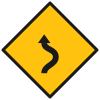
What lies ahead when you see this sign?
A A. A slippery road surfaceB B. A steep hill aheadC C. A series of curvesD D. A narrow bridge
Question 10 of 25 Safe driving and hazards (New Mexico)
According to the New Mexico Driver Manual, when you turn on your wipers, what else should you turn on?
A A. Your hazard flashersB B. Your headlightsC C. Your high beamsD D. Your parking lights only
Question 11 of 25 Speed and following distance
Why should you slow down as you near the top of a hill?
A A. To save fuel on the way down the other sideB B. You cannot see what is over the topC C. Because your brakes work less wellD D. Because the speed limit is lower
Question 12 of 25 Emergencies and equipment
A front tire blows out. What should you do?
A A. Brake hard right away to stop fastB B. Hold the wheel firmly and ease off the gasC C. Turn the wheel sharply to the shoulderD D. Speed up to keep control of the car
Question 13 of 25 Right of way (New Mexico)
A New Mexico school bus is stopped with red lights flashing at an intersection you are coming to. What must you do?
A A. StopB B. Turn away from the bus and go onC C. Slow down and pass with careD D. Stop only if you are behind it
Question 14 of 25 Alcohol, drugs and penalties (New Mexico)
According to the New Mexico Driver Manual, how soon does alcohol reach your brain?
A A. In 1 to 2 minutesB B. In 2 to 3 hoursC C. In 6 to 8 hoursD D. In 20 to 40 minutes
Question 15 of 25 Road signs
A speed sign on a highway shows "MINIMUM 40". What does it mean?
A A. You must drive at least 40 even in heavy snowB B. Trucks must not go faster than 40C C. You should not drive below 40 in good conditionsD D. 40 is the speed limit for all drivers at night
Question 16 of 25 Right of way
You are pulling into a driveway and a person is walking on the sidewalk. What should you do?
A A. Turn in front of them quicklyB B. Stop and let them pass firstC C. Honk so they stopD D. Drive slowly around them
Question 17 of 25 Emergencies and equipment
When should you use your hazard warning lights?
A A. When parking in a no-parking zoneB B. When your stopped car could be a hazardC C. When driving in light rain or mistD D. When you are late and driving fast
Question 18 of 25 Right of way
A cyclist on your right and you arrive at an all-way stop together. What should you do?
A A. Go first, since bikes must always yieldB B. Let the cyclist go firstC C. Go first if you are going straightD D. Go first, since your vehicle is larger
Question 19 of 25 Parking and stopping
You park on a hill with no curb, facing up or down. Which way should you turn your wheels?
A A. Toward the edge of the roadB B. Toward the middle of the roadC C. Straight aheadD D. Away from the edge
Question 20 of 25 Parking and stopping (New Mexico)
In New Mexico, how close to a fire hydrant may you park?
A A. No closer than 3 feetB B. No closer than 8 feetC C. No closer than 12 feetD D. No closer than 15 feet
Question 21 of 25 Right of way
Why must drivers always yield to trains at a crossing?
A A. Trains are always on a set scheduleB B. Trains cannot stop quickly or steer awayC C. Trains have stop signs at crossings tooD D. Train crossings are private land
Question 22 of 25 Signals and pavement markings (New Mexico)
At some New Mexico signals, a small, very bright light blinks in the middle of the red light. What is it for?
A A. To show that you may turn right without stoppingB B. To warn you that the signal is broken todayC C. To tell you that a train is comingD D. To alert you that the light is red and you must stop
Question 23 of 25 Signals and pavement markings
A flashing "DON'T WALK" or raised hand signal means people on foot should:
A A. Cross quickly before it turns steadyB B. Stop and wait in the middle of the roadC C. Cross only if they can run the whole wayD D. Not start, but finish if already crossing
Question 24 of 25 Turning, passing and lanes (New Mexico)
After passing on a New Mexico road, when is it safe to return to your lane?
A A. When you see both headlights of the passed car in your mirrorB B. As soon as your front bumper clears its front bumperC C. When the other driver flashes the headlights at youD D. When you are one full car length ahead of it
Question 25 of 25 Road signs
Green signs on a highway show:
A A. Rules that you must obeyB B. Hazards such as sharp curvesC C. Work zones, detours and lane closuresD D. Directions, exits and distances
Answer each question to see the explanation. Keyboard: A–D or 1–4 to answer, N next, P previous.