Question 1 of 40 Safe driving and hazards
The headlights of an oncoming car are blinding you. Where should you look?
A A. Straight into the oncoming lightsB B. Toward the right edge of your laneC C. At the center line next to the carD D. Down at your dashboard until it passes
Question 2 of 40 Alcohol, drugs and penalties
You drank a lot late last night. Could you still be impaired the next morning?
A A. Yes, alcohol can still be in your bloodB B. No, sleep removes all of the alcoholC C. No, not if you eat a big breakfastD D. Only if you still feel sick
Question 3 of 40 Turning, passing and lanes (Kentucky)
May a Kentucky driver cross the center line in a no-passing zone to pass a cyclist?
A A. Yes, if the left side is clear far enough aheadB B. No, never in a no-passing zoneC C. Only if the cyclist waves you byD D. Only on roads with no lane lines
Question 4 of 40 Right of way
Your light turns green, but an ambulance with flashing lights and a siren is coming. What should you do?
A A. Stay stopped and let it go byB B. Go, since you have the green lightC C. Turn right to get out of the wayD D. Speed up to clear the intersection
Question 5 of 40 Sharing the road
How should you pass a person riding a horse?
A A. Quickly, with a short honk to warn themB B. Slowly, with plenty of room and no hornC C. Close by, so you get past soonerD D. With your high beams on so they see you
Question 6 of 40 Safe driving and hazards
The back of your car starts to skid. What should you do?
A A. Ease off the gas and steer where you want to goB B. Brake hard and hold the wheel very stillC C. Speed up to pull out of itD D. Steer the other way as hard as you can
Question 7 of 40 Sharing the road
When may a cyclist ride in the middle of a traffic lane?
A A. Never; cyclists must stay at the edgeB B. Only on highways and freewaysC C. When the lane is too narrow to share safelyD D. Only at night with lights on
Question 8 of 40 Emergencies and equipment
Your right wheels drift off the edge of the pavement. What should you do?
A A. Jerk the wheel back right awayB B. Brake hard while still on the edgeC C. Ease off the gas and steer back gentlyD D. Speed up to climb back onto the road
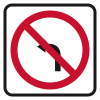
Question 9 of 40 Road signs
What is not allowed where this sign is posted?
A A. Turning rightB B. Going straightC C. Changing lanesD D. Turning left
Question 10 of 40 Right of way
You are coming up to a roundabout and someone is waiting at the crosswalk before it. What should you do?
A A. Enter, since the roundabout comes firstB B. Speed up to clear the crosswalkC C. Stop and let them cross before enteringD D. Honk and then enter
Question 11 of 40 Turning, passing and lanes
A long line of cars is behind you on a two-lane road. What should you do?
A A. Speed up past the limit to keep upB B. Pull over where safe and let them passC C. Brake now and then to slow them downD D. Keep going at your speed and ignore them
Question 12 of 40 Speed and following distance
Compared to dry pavement, stopping on ice takes:
A A. Much longerB B. About the same distanceC C. Less distanceD D. Only a little longer
Question 13 of 40 Turning, passing and lanes
Where is a U-turn most likely to be unsafe or not allowed?
A A. On a quiet street with a clear view both waysB B. At a light that has a U-turn arrowC C. Near a curve or hill where others cannot see youD D. On a wide road with no traffic in sight
Question 14 of 40 Parking and stopping
Why is it unsafe to stop or park on railroad tracks?
A A. A train could hit your carB B. It can damage your tiresC C. It is only unsafe at nightD D. It blocks people walking
Question 15 of 40 Turning, passing and lanes
To make a right turn, where should your car be?
A A. In the left lane, ready to swing wideB B. In the middle of the road, near the lineC C. In any lane that has room for youD D. In the right lane, close to the curb
Question 16 of 40 Turning, passing and lanes
Why should you avoid changing lanes in an intersection?
A A. It is fine if you signal before the intersectionB B. Others may not expect it, and it can cause a crashC C. It saves time and keeps traffic movingD D. It is only a problem at night or in rain
Question 17 of 40 Sharing the road (Kentucky)
How old must you be to ride an electric low-speed scooter on a Kentucky highway or bike lane?
A A. 10 or olderB B. 13 or olderC C. 14 or olderD D. 16 or older
Question 18 of 40 Road signs (Kentucky)
At some Kentucky rail crossings with more than one track, what will a sign show?
A A. The time of the next trainB B. The top train speedC C. The number of tracksD D. The distance to the station
Question 19 of 40 Turning, passing and lanes
You are waiting to turn left with oncoming traffic. How should you hold your front wheels?
A A. Straight ahead until you start to turnB B. Turned to the left, ready to goC C. Turned a little to the rightD D. It does not matter how they point
Question 20 of 40 Signals and pavement markings
A steady yellow X appears over your lane. What does it mean?
A A. The lane is open for all trafficB B. The lane is for turning left onlyC C. You may stop in the laneD D. Get ready to leave the lane safely
Question 21 of 40 Safe driving and hazards
What does it mean to drive defensively?
A A. Drive fast so you stay ahead of othersB B. Honk often to warn others you are nearC C. Always take the right-of-way when you have itD D. Expect others to make mistakes and be ready
Question 22 of 40 Right of way
You have stopped at a stop line, but your view of the cross street is blocked. What should you do?
A A. Go at normal speed and hope it is clearB B. Honk loudly and go straight throughC C. Back up to get a better viewD D. Edge forward until you can see, then go
Question 23 of 40 Right of way
At a four-way stop, who should go first?
A A. The driver in the biggest vehicleB B. The driver going the fastestC C. The driver turning leftD D. The driver who stopped first
Question 24 of 40 Turning, passing and lanes (Kentucky)
What does the Kentucky manual say about staying in the left lane on a limited-access highway?
A A. It is fine at the speed limitB B. It is allowed only at nightC C. It is required for large trucksD D. It is illegal
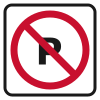
Question 25 of 40 Road signs
What does this sign mean?
A A. You may park here for a short timeB B. This lot is for permit holders onlyC C. Parking is free on this streetD D. You may not park here
Question 26 of 40 Speed and following distance
How does higher speed affect what you can see?
A A. Your side vision narrowsB B. Your side vision widensC C. You see more detail at the sidesD D. It has no effect
Question 27 of 40 Signals and pavement markings (Kentucky)
You enter a Kentucky intersection on a yellow light, and it turns red while you are in it. What does the manual say?
A A. You must stop where you areB B. You must back up behind the lineC C. You may clear the intersectionD D. You have run the red light
Question 28 of 40 Signals and pavement markings
You reach an intersection where the traffic lights are not working at all. In general, what should you do?
A A. Go through at normal speedB B. Treat it as an all-way stopC C. Treat it as a yield for you onlyD D. Turn around and find another road
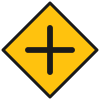
Question 29 of 40 Road signs
What does this sign tell you is ahead?
A A. A railroad crossing aheadB B. Another road crosses yoursC C. A hospital entranceD D. The end of a divided road
Question 30 of 40 Signals and pavement markings
White lines between lanes separate:
A A. Traffic moving in opposite directionsB B. Lanes of traffic moving the same wayC C. The road from a railroad trackD D. A school zone from the road
Question 31 of 40 Alcohol, drugs and penalties (Kentucky)
What is the fine range for a first DUI in 10 years in Kentucky, not counting court costs?
A A. $50 to $100B B. $100 to $150C C. $150 to $200D D. $200 to $500
Question 32 of 40 Speed and following distance (Kentucky)
Per the Kentucky manual, what is the top suggested speed for most cars towing a trailer?
A A. 40 mphB B. 45 mphC C. 50 mphD D. 55 mph
Question 33 of 40 Sharing the road
An orange triangle with a red border on the back of a vehicle means:
A A. It carries dangerous goodsB B. It is a slow-moving vehicleC C. It is a school bus or vanD D. It is broken down or stalled
Question 34 of 40 Speed and following distance (Kentucky)
According to the Kentucky manual, what is the least following distance to keep behind the car ahead?
A A. 3 secondsB B. 4 secondsC C. 5 secondsD D. 6 seconds
Question 35 of 40 Sharing the road
Why should you stay well back from a snowplow?
A A. It always drives faster than carsB B. It throws snow and may stop suddenlyC C. It has no lights or signalsD D. It must yield to all other cars
Question 36 of 40 Right of way
You are at a stop sign. A car on the cross street is signaling a turn onto your road but has not slowed down yet. What is safest?
A A. Pull out, since it is going to turnB B. Pull out fast before it reaches youC C. Wait until it clearly starts to turnD D. Honk and then pull out in front of it
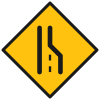
Question 37 of 40 Road signs
You are in the lane that this sign says will end. What should you do?
A A. Stop at the end of the lane and waitB B. Speed up and pass cars in the next laneC C. Signal and merge when there is a safe gapD D. Stay in it, since lanes like this reopen soon
Question 38 of 40 Right of way (Kentucky)
In Kentucky, how close may you follow a fire truck or other emergency vehicle?
A A. No closer than 150 feetB B. No closer than 500 feetC C. No closer than 250 feetD D. No closer than 1,000 feet
Question 39 of 40 Alcohol, drugs and penalties (Kentucky)
For an adult, how long is the license suspension for a first DUI conviction in Kentucky?
A A. 4 to 6 monthsB B. 7 to 9 monthsC C. 10 to 12 monthsD D. 18 to 24 months
Question 40 of 40 Safe driving and hazards
Which of these is a cognitive distraction?
A A. Looking at a billboardB B. Daydreaming about your plansC C. Tuning the radio by handD D. Reaching for a drink in a cup holder
Answer each question to see the explanation. Keyboard: A–D or 1–4 to answer, N next, P previous.