Question 1 of 32 Safe driving and hazards
Why is texting while driving so dangerous?
A A. It drains your phone battery fasterB B. It is only dangerous when driving at nightC C. It is only a problem on busy highwaysD D. It takes your eyes and mind off the road
Question 2 of 32 Signals and pavement markings
What must you do at a steady red traffic light?
A A. Slow down and go if the road is clearB B. Stop only if cars are crossingC C. Go if you are turning leftD D. Stop and wait behind the stop line
Question 3 of 32 Licensing and insurance (Delaware)
What is the least Personal Injury Protection (PIP) coverage for one person on a Delaware car policy?
A A. $5,000B B. $15,000C C. $20,000D D. $40,000
Question 4 of 32 Safe driving and hazards (Delaware)
Under Delaware law, when must your headlights be on in the daytime?
A A. Any time you use your windshield wipersB B. Only on interstate highwaysC C. Only when it is snowing hardD D. Only when an officer tells you to
Question 5 of 32 Turning, passing and lanes
When might you need a three-point turn?
A A. To park on a hill with a curbB B. To pass a slow car on a narrow roadC C. To enter a highway from a rampD D. To turn around on a narrow street
Question 6 of 32 Road signs
Green signs on a highway show:
A A. Rules that you must obeyB B. Hazards such as sharp curvesC C. Work zones, detours and lane closuresD D. Directions, exits and distances
Question 7 of 32 Signals and pavement markings
What do two solid yellow lines down the center of the road mean?
A A. Passing is allowed from both sidesB B. The lane is for turning left onlyC C. The road is one-wayD D. No passing from either side
Question 8 of 32 Emergencies and equipment
A front tire blows out. What should you do?
A A. Brake hard right away to stop fastB B. Hold the wheel firmly and ease off the gasC C. Turn the wheel sharply to the shoulderD D. Speed up to keep control of the car
Question 9 of 32 Emergencies and equipment (Delaware)
According to the Delaware manual, if a car fire gets out of control, how far away should you move?
A A. At least 10 feetB B. At least 35 feetC C. At least 100 feetD D. At least 60 feet
Question 10 of 32 Signals and pavement markings
What does a steady green light mean?
A A. Go at once, since green means you have the roadB B. Stop first and then go when it is clearC C. Go if the way is clear, yielding as neededD D. Only turns are allowed until the light changes
Question 11 of 32 Alcohol, drugs and penalties (Delaware)
A Delaware juvenile is found guilty of DUI. Until when is the license revoked?
A A. Until they turn 18B B. Until they finish driver educationC C. Until they finish high schoolD D. Until they turn 21
Question 12 of 32 Turning, passing and lanes
In what order should you change lanes?
A A. Move over first, then signal and checkB B. Check your mirrors, move over, then signalC C. Signal, check mirrors and blind spot, then moveD D. Signal and move over at the same time
Question 13 of 32 Signals and pavement markings
A center lane is marked with a solid yellow line and a broken yellow line on each side. What is it for?
A A. Passing slow traffic on a two-lane roadB B. Buses, taxis and carpools onlyC C. Left turns by traffic from both directionsD D. Parking for short stops and deliveries
Question 14 of 32 Road signs
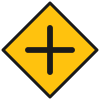
What does this sign tell you is ahead?
A A. A railroad crossing aheadB B. Another road crosses yoursC C. A hospital entranceD D. The end of a divided road
Question 15 of 32 Road signs
A speed sign on a highway shows "MINIMUM 40". What does it mean?
A A. You must drive at least 40 even in heavy snowB B. Trucks must not go faster than 40C C. You should not drive below 40 in good conditionsD D. 40 is the speed limit for all drivers at night
Question 16 of 32 Turning, passing and lanes (Delaware)
You want to make a U-turn at a Delaware roundabout with two approach lanes. Which lane should you use?
A A. The left approach laneB B. The right approach laneC C. Either lane you likeD D. The right lane, then cut across
Question 17 of 32 Emergencies and equipment
You are in a crash and someone is hurt. What should you do?
A A. Drive away to find helpB B. Move the injured person right awayC C. Wait for someone else to callD D. Stop, call 911, and help if you can
Question 18 of 32 Turning, passing and lanes
How should you turn left from a one-way street onto another one-way street?
A A. From the right lane into the right laneB B. From the far left lane into the far left laneC C. From the left lane into the right laneD D. From any lane into whatever lane is open
Question 19 of 32 Sharing the road
You are turning right and a cyclist is riding in the bike lane next to you. What should you do?
A A. Let the cyclist pass, then turnB B. Turn in front of the cyclistC C. Honk, then make your turnD D. Speed up so you turn first
Question 20 of 32 Signals and pavement markings
The light is green, but traffic is backed up on the far side of the intersection. What should you do?
A A. Pull into the intersection and wait there for roomB B. Wait until there is room to clear the intersectionC C. Sound your horn to move traffic alongD D. Use the crosswalk to wait out of the way of others
Question 21 of 32 Road signs
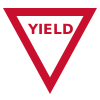
What does this sign tell you to do?
A A. Let traffic with the right-of-way go firstB B. Stop every time, even when the road is emptyC C. Speed up to merge ahead of other trafficD D. Keep going, since others must yield to you
Question 22 of 32 Alcohol, drugs and penalties
How does alcohol affect your vision at night?
A A. It slows how fast your eyes recover from glareB B. It makes you see better in the darkC C. It has no effect on your vision at nightD D. It only changes how you see colors
Question 23 of 32 Alcohol, drugs and penalties
Which ability does alcohol usually affect first?
A A. HearingB B. Sense of smellC C. Muscle strengthD D. Judgment
Question 24 of 32 Speed and following distance (Delaware)
Unless signs say otherwise, what is the speed limit on a Delaware two-lane road?
A A. 35 mphB B. 45 mphC C. 50 mphD D. 60 mph
Question 25 of 32 Signals and pavement markings (Delaware)
In Delaware, the small rectangular lights on a crosswalk sign flash in a fast "stutter" pattern. What should you do?
A A. Speed up to clear the crosswalk firstB B. Slow down, look for people crossing, and yieldC C. Stop and wait one full minute before you go onD D. Treat it like a closed lane and merge
Question 26 of 32 Alcohol, drugs and penalties
What usually happens if you refuse a lawful breath or blood test?
A A. Nothing, it is your rightB B. Your license can be suspendedC C. You get a warning onlyD D. You must take a driving class
Question 27 of 32 Speed and following distance
You are following a car in heavy traffic. What should you do?
A A. Follow close so no one can cut inB B. Change lanes often to get aheadC C. Look only at the car right in front of youD D. Keep a steady gap and watch for brake lights
Question 28 of 32 Turning, passing and lanes
Before turning right, what should you watch for on your right?
A A. Cars in the far left laneB B. Planes landingC C. Cyclists and people walkingD D. Traffic behind the car ahead
Question 29 of 32 Road signs
On an Interstate route sign, what does an odd route number usually tell you?
A A. The highway runs mostly east and westB B. The highway is a toll road for its whole lengthC C. The highway loops around a cityD D. The highway runs mostly north and south
Question 30 of 32 Sharing the road
A person in a wheelchair is crossing the street. What should you do?
A A. Drive around themB B. Honk so they hurryC C. Go if your light is greenD D. Wait until they have crossed
Question 31 of 32 Alcohol, drugs and penalties
Marijuana is legal for adults in some states. Is it legal to drive while impaired by it?
A A. Yes, in states where it is legalB B. Yes, if you have a medical cardC C. Yes, if you used only a small amountD D. No, impaired driving is illegal everywhere
Question 32 of 32 Safe driving and hazards (Delaware)
Delaware law requires your headlights to be on any time you cannot see beyond what distance?
A A. 250 feetB B. 750 feetC C. 1,000 feetD D. 2,000 feet
Answer each question to see the explanation. Keyboard: A–D or 1–4 to answer, N next, P previous.