Question 1 of 25 Sharing the road (Colorado)
In Colorado, how much space must you give a bicyclist when you pass?
A A. At least 2 feetB B. At least 4 feetC C. At least 3 feetD D. At least 6 feet
Question 2 of 25 Turning, passing and lanes (Colorado)
In Colorado, when may a driver cross a bike lane?
A A. To pass slow cars on the right sideB B. When turning or entering a road, driveway or alleyC C. To wait in it during a traffic jamD D. Never, not even to make a turn
Question 3 of 25 Road signs
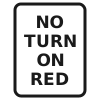
What does this sign mean while the light is red?
A A. You may turn right after a full stopB B. You may turn only if no one is comingC C. You must turn and may not go straightD D. You may not turn, even after you stop
Question 4 of 25 Road signs (Colorado)
A Colorado railroad crossing in a quiet zone has a "No Train Horn" sign. What warns you of a train there?
A A. A bell on the crossbuck postB B. A flagger at the crossingC C. The flashing lights and gatesD D. A soft train horn
Question 5 of 25 Safe driving and hazards
Which headlights should you use in fog?
A A. High beamsB B. Parking lights onlyC C. Low beamsD D. No lights
Question 6 of 25 Speed and following distance
Why is it unsafe to drive faster than your lights can show at night?
A A. You may not see a hazard in time to stopB B. Your headlights may burn out soonerC C. Other drivers will flash their lights at youD D. You will use more fuel than usual
Question 7 of 25 Right of way (Colorado)
In Colorado, when must you yield to a transit bus that is pulling into traffic?
A A. When it signals and its rear yield sign is litB B. Only when it is full of ridersC C. Only if it is in the left laneD D. Never; it must wait for a gap
Question 8 of 25 Road signs
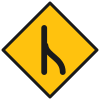
You are on the main road and see this sign. What is the best thing to do?
A A. Watch for cars joining and adjust your speedB B. Speed up so no one can get in front of youC C. Stop and wait until no cars are joiningD D. Hold your speed and let them find a gap
Question 9 of 25 Alcohol, drugs and penalties
You are in a crash. Is it legal to drive away without stopping?
A A. Yes, if no one is hurtB B. Yes, if it was not your faultC C. Yes, if the damage is smallD D. No, you must stop
Question 10 of 25 Turning, passing and lanes
Why is weaving from lane to lane dangerous?
A A. It wears out your tires and brakesB B. It is fine on empty roadsC C. It is safe if you signalD D. It raises the chance of a crash
Question 11 of 25 Emergencies and equipment (Colorado)
According to the Colorado handbook, during "Accident Alert" status, how soon must a minor no-injury crash be reported to police?
A A. Within 2 hoursB B. Within 24 hoursC C. Within 72 hoursD D. Within 10 days
Question 12 of 25 Right of way
You have stopped at a stop line, but your view of the cross street is blocked. What should you do?
A A. Go at normal speed and hope it is clearB B. Honk loudly and go straight throughC C. Back up to get a better viewD D. Edge forward until you can see, then go
Question 13 of 25 Road signs
What does this white X-shaped sign mark?
A A. A four-way crossroadB B. A railroad crossingC C. A hospital zoneD D. A closed road ahead
Question 14 of 25 Road signs
Signs that are taller than they are wide, in white with black letters, usually:
A A. Warn of a hazard aheadB B. Show the way to placesC C. Give a rule you must obeyD D. Point out parks and sights
Question 15 of 25 Sharing the road
A vehicle is stopped on the shoulder with flashing emergency lights. What should you do?
A A. Keep your speed and stay in your laneB B. Stop in your lane until it leavesC C. Speed up to pass it quicklyD D. Move over a lane, or slow down
Question 16 of 25 Parking and stopping (Colorado)
When you parallel park in Colorado, how close to the curb must your car be?
A A. Within 12 inchesB B. Within 18 inchesC C. Within 24 inchesD D. Within 36 inches
Question 17 of 25 Signals and pavement markings
Arrows painted in your lane show:
A A. Where you may park along the curbB B. Where people on foot may crossC C. Which way traffic in that lane may goD D. The speed limit for that lane
Question 18 of 25 Alcohol, drugs and penalties
How does alcohol affect your driving?
A A. It slows your reactions and blurs visionB B. It makes you more alert and carefulC C. It improves your vision at nightD D. It has no effect in small amounts
Question 19 of 25 Sharing the road
How should you pass a person riding a horse?
A A. Quickly, with a short honk to warn themB B. Slowly, with plenty of room and no hornC C. Close by, so you get past soonerD D. With your high beams on so they see you
Question 20 of 25 Right of way
At an intersection with no signs, you want to turn left. An oncoming car is going straight. What should you do?
A A. Turn first, since you got there firstB B. Turn while signalingC C. Wave the car through and turn in front of itD D. Yield to the oncoming car
Question 21 of 25 Right of way
In general, how should you treat a funeral procession?
A A. Pass through any gaps in the lineB B. Yield and do not cut into the lineC C. Join the end of the line to follow itD D. Honk to make it move faster
Question 22 of 25 Right of way
You are at a stop sign. A car on the cross street is signaling a turn onto your road but has not slowed down yet. What is safest?
A A. Pull out, since it is going to turnB B. Pull out fast before it reaches youC C. Wait until it clearly starts to turnD D. Honk and then pull out in front of it
Question 23 of 25 Parking and stopping
May you park in a disability space without a valid placard or plate?
A A. Yes, for a short stopB B. Yes, at nightC C. No, it is not allowedD D. Yes, if the lot is full
Question 24 of 25 Alcohol, drugs and penalties
What kind of drug is alcohol?
A A. A stimulant that speeds you upB B. A depressant that slows the brainC C. A vitamin that the body needsD D. A pain reliever with no side effects
Question 25 of 25 Parking and stopping
When you finish parallel parking, where should your car be?
A A. At an angle, with the back sticking outB B. Close to and lined up with the curbC C. Touching the bumper of the car behindD D. With two wheels up on the sidewalk
The timer starts when you answer the first question. Keyboard: A–D or 1–4 to answer, N next, P previous.