Road-sign questions 20 questions · Pass mark: 16 of 20 (80%) · No time limit
Time taken 0:00
Finish test
Questions
1 2 3 4 5 6 7 8 9 10 11 12 13 14 15 16 17 18 19 20
Question 1 of 20 Road and traffic signs
This sign has a blue centre, but also a red ring. What does the red ring tell you?
A A. It is a positive order you must followB B. It is a warning of danger aheadC C. It is advice that you may ignoreD D. It shows a ban, not an instruction
Question 2 of 20 Road and traffic signs
Two junctions of this type are placed close together. How should you treat them?
A A. As one junction, giving way only onceB B. As a crossroads with no priorityC C. Each one by going first if you signalD D. Each one separately, giving way to the right
Question 3 of 20 Road and traffic signs
A cyclist rides up to this sign. There is no plate below it. Does the sign apply to the cyclist?
A A. Yes, a bicycle is a vehicle tooB B. No, it applies only to motor vehiclesC C. No, cyclists may enter if they take careD D. Only during the times shown nearby
Question 4 of 20 Road and traffic signs
What will you find if you drive into the road this sign marks?
A A. No way out for vehicles at the endB B. A road closed to all trafficC C. A road for buses and taxis onlyD D. A road where traffic may only go one way
Question 5 of 20 Road and traffic signs
How does the light sequence at this crossing differ from a puffin or toucan crossing?
A A. It has a flashing amber phaseB B. It has no red light for trafficC C. It has a flashing green phaseD D. It shows red and amber together
Question 6 of 20 Road and traffic signs
This sign is on your side of a narrow bridge. What sign will drivers coming the other way normally see?
A A. One telling them to give way to youB B. One giving them priority as wellC C. One showing the national speed limitD D. One telling them the road is closed
Question 7 of 20 Road and traffic signs
After this sign the car ahead is driving 10 mph below the limit. What must you do?
A A. Overtake it quicklyB B. Stay behind itC C. Flash it to pull overD D. Pass it on the left
Question 8 of 20 Road and traffic signs
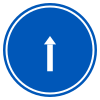
Is this blue sign with a white arrow advice or an order?
A A. Advice you may ignoreB B. A hint for lorry driversC C. An order you must obeyD D. A warning of a sharp bend
Question 9 of 20 Road and traffic signs
After this sign you find the crossroads has no road markings or give way signs. Who has priority?
A A. Traffic going straight onB B. Nobody, so be ready to give wayC C. Traffic coming from the leftD D. The larger of the vehicles
Question 10 of 20 Road and traffic signs
Animals are close to the road after this sign. Which of these should you avoid?
A A. Sounding your hornB B. Giving them roomC C. Driving slowlyD D. Being ready to stop
Question 11 of 20 Road and traffic signs
Lanes are closing at the works this sign warns of. How should traffic join into the open lane?
A A. Merge at the first signB B. Move over at the last coneC C. Merge in turnD D. Pass the queue then cut in
Question 12 of 20 Road and traffic signs
Near the crossing this sign warns of, which vehicle must you not overtake?
A A. Any vehicle over 3 metres highB B. A bus that has its lights onC C. A car that is turning leftD D. The one nearest the crossing
Question 13 of 20 Road and traffic signs
At the junction this sign marks, whom must you give way to?
A A. Vehicles coming from your immediate leftB B. Vehicles going straight acrossC C. Vehicles that signal firstD D. Vehicles from your immediate right
Question 14 of 20 Road and traffic signs
Your sat nav tells you to turn right where this sign is. What should you do?
A A. Obey the sign and let the sat nav rerouteB B. Follow the sat nav as it is more up to dateC C. Turn right if the road is emptyD D. Turn right but drive slowly
Question 15 of 20 Road and traffic signs
A crossing of this type has an island in the middle. How is it treated?
A A. As one single crossingB B. As a crossing for cyclesC C. As two separate crossingsD D. As a crossing with lights
Question 16 of 20 Road and traffic signs
Most lit roads in built-up areas of Wales have a 20 mph limit. You pass this sign in Wales. What is the limit now?
A A. 20 mphB B. 30 mphC C. 40 mphD D. 50 mph
Question 17 of 20 Road and traffic signs
You reach the lights this sign warns of, but they are not working. How should you treat the junction?
A A. As if you have the right of wayB B. As an unmarked junction, with great careC C. As if the lights were on greenD D. As if the lights were stuck on red for good
Question 18 of 20 Road and traffic signs
How should you drive through the junctions shown on this sign?
A A. Quickly, to get clear of themB B. In the centre to block side roadsC C. Slowly, ready for vehicles emergingD D. Close to the car ahead of you
Question 19 of 20 Road and traffic signs
How long does the ban shown by this sign last?
A A. Until a sign ends the banB B. Until the next junction you reachC C. For the next 100 yards onlyD D. Until the road becomes wider
Question 20 of 20 Road and traffic signs
At this crossing, when MUST you give way by law?
A A. When someone has stepped onto itB B. Only when the beacons flash fasterC C. Only when a child is waitingD D. Only when there is a lollipop sign
Answer each question to see the explanation. Keyboard: A–D or 1–4 to answer, N next, P previous.
View
Restart
Turn on JavaScript to answer questions, see explanations and get your score.
GB traffic signs as published in the official 'Know your traffic signs' book (one of the 3 books the multiple-choice questions are based on). 16 correct (80%) is our practice mark, not an official pass mark.
Link to this quiz Driving instructors, schools and learner forums are welcome to link to this free road-sign quiz.
United Kingdom road signs and what they mean Our own simplified drawings of the signs learners meet most. The full list, with meanings, is in the United Kingdom sign library ; the official reference is the The Highway Code (plus 'Know your traffic signs' and 'Driving - the essential skills') .
Regulatory signs Stop and give way
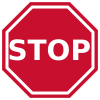
Stop at the line, then give way to traffic on the major road before moving off.
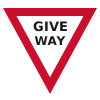
Give way to traffic on major road
Give way to traffic on the road ahead; you need not stop if the way is clear.
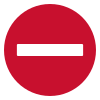
No entry for vehicular traffic
Vehicles must not enter the road from this direction.
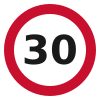
Maximum speed 30 mph
You must not go faster than 30 mph here.
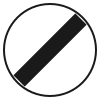
National speed limit applies
The national limit for your type of vehicle and road now applies.
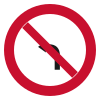
No left turn
Left turns are not allowed.
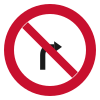
No right turn
Right turns are not allowed.
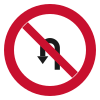
No U-turns
You must not turn round to go back the way you came.
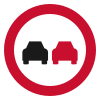
No overtaking
You must not overtake other vehicles.
No vehicles
No vehicles may use the road (pushing a bicycle is allowed).
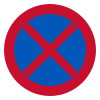
No stopping (clearway)
You must not stop on the main carriageway at any time, even to pick up or set down.
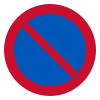
No waiting
You must not wait or park here during the times shown, though you may stop briefly to load or let people in or out.
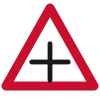
Warning signs Crossroads
A crossroads is ahead; watch for traffic from both sides.
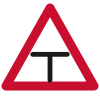
T-junction with priority over vehicles from the right
The road ends at a T-junction ahead.
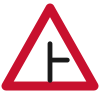
Side road
A side road joins ahead.
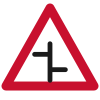
Staggered junction
Two side roads join ahead, offset from each other.
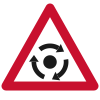
Roundabout
A roundabout is ahead; slow down and get into the correct lane.
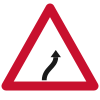
Bend to right
The road bends right ahead.
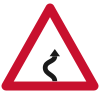
Double bend first to left
Two bends follow each other, the first to the left.
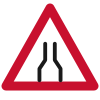
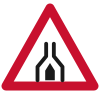
Road narrows on both sides
The road gets narrower on both sides ahead.
Dual carriageway ends
The central reservation ends; traffic in both directions will share one road.
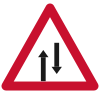
Two-way traffic straight ahead
Expect oncoming traffic on the road ahead.
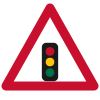
Traffic signals
Traffic lights are ahead; be ready to stop.
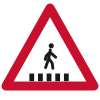
Pedestrian crossing
A pedestrian crossing is ahead; be ready to stop for people crossing.
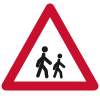
Children going to or from school
Children may be crossing or near the road, often by a school.
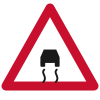
Slippery road
The surface may be slippery; slow down and avoid harsh braking.
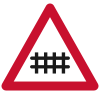
Level crossing with barrier or gate ahead
A railway level crossing with barriers or gates is ahead.
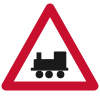
Level crossing without barrier or gate ahead
A railway level crossing without barriers is ahead; look and listen for trains.
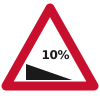
Steep hill downwards
A steep downhill is ahead; use a lower gear and control your speed.
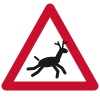
Wild animals
Wild animals such as deer may be on the road.
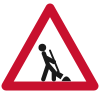
Road works
Road works are ahead; slow down and follow temporary signs.
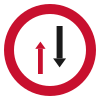
Priority signs Give way to oncoming vehicles
Oncoming traffic has priority through the narrow section; wait for it to clear.
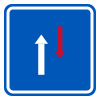
Priority over oncoming vehicles
You have priority over oncoming traffic through the narrow section ahead, but still take care.
Mandatory signs Ahead only
You must go straight on.
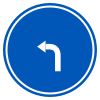
Turn left
You must turn left (or turn left ahead if on a plate).
Keep left
Keep to the left of the island or obstruction.
Mini-roundabout
Give way to traffic from the right and go clockwise around the central marking.
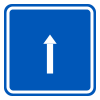
One-way traffic
Traffic on this road goes one way only, in the direction of the arrow.
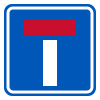
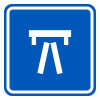
No through road
The road is a dead end; there is no exit at the far end.
Start of motorway
Motorway rules apply from this point.
Zebra crossing
Flashing amber beacons and black-and-white stripes mark a crossing where you must give way to people who have stepped onto it.
Pelican crossing
A light-controlled crossing; a flashing amber light means give way to anyone still crossing, then go if clear.
Countdown markers
Mark 300, 200 and 100 yards to an exit or concealed level crossing.
Next Advertisement