Question 1 of 30 Signs and markings
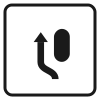
Your lane has a painted arrow that points straight ahead and also curves to the right. What may you do at the intersection?
A A. Turn right only, as it is the inside laneB B. Go straight only, unless the lane is emptyC C. Turn left, turn right or go straight onD D. Go straight ahead or turn right
Question 2 of 30 Hazards and sharing the road
A kangaroo is standing on the road in front of you at night. What should you do?
A A. Swerve sharply around it onto the road shoulderB B. Brake slowly, sound the horn and flash your headlightsC C. Speed up so you pass by before it moves againD D. Switch your lights off so it is not dazzled by them
Question 3 of 30 Signs and markings
A painted island ahead is edged by one continuous line. A turning lane begins right after it. How far may you drive on the island to enter that lane?
A A. 15 metresB B. 30 metresC C. 50 metresD D. 75 metres
Question 4 of 30 Safe driving
Your car has electronic stability control (ESC). What does it do when it senses the car starting to slide?
A A. It brakes individual wheels to steady the carB B. It cuts the engine and stops the car at onceC C. It locks all four wheels to stop the slideD D. It turns the steering wheel back for you
Question 5 of 30 Road rules
You want to make a U-turn at an intersection with traffic lights. There is no sign about U-turns. What does the rule say?
A A. You may U-turn on a green light if safeB B. You may U-turn only on a green arrowC C. You must not make a U-turn thereD D. You may U-turn if no cars are coming
Question 6 of 30 Signs and markings
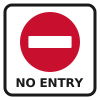
Your GPS tells you to turn into a street, but this sign faces you at its entrance. What should you do?
A A. Enter slowly and keep well to the leftB B. Enter only if no cars are coming outC C. Enter, as your GPS knows the wayD D. Do not enter, and find another route
Question 7 of 30 Signs and markings
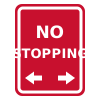
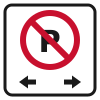
Your car breaks down on a street where this sign applies. What does the rule allow?
A A. You must push the car on until it is past the zoneB B. You may leave the car there for as long as you likeC C. You must not stop there for any reason, even this oneD D. You may stop, but must move the car as soon as you can
Question 8 of 30 Learner and P-plate rules
You are 22 and hold a P2 licence in South Australia. A friend offers to lend you his high-powered car. What applies?
A A. You must not drive it unless you hold an exemptionB B. You may drive it now that you are on your P2C C. You may drive it with a full licence holder beside youD D. You may drive it as long as it is outside the city
Question 9 of 30 Road rules
You are on the entry road to a freeway and there is a safe gap in traffic. How should you join the freeway?
A A. Speed up along the entry road and merge at traffic speedB B. Stop at the end of the entry road, then pull outC C. Enter slowly and let freeway traffic slow for youD D. Drive across the painted island to join sooner
Question 10 of 30 Road rules
You want to stop near a zebra crossing. Unless a sign allows it, which stretch of road must you keep clear?
A A. 10 metres before and 20 metres after the crossingB B. 10 metres before and 10 metres after the crossingC C. 20 metres before and 10 metres after the crossingD D. 20 metres before and 20 metres after the crossing
Question 11 of 30 Road rules
At a children's crossing, a school crossing monitor holds up a STOP sign towards you. When may you drive on?
A A. As soon as the children reach the footpathB B. Only when the sign is no longer shown to youC C. Once the children are past the middle of the roadD D. After you have stopped for two full seconds
Question 12 of 30 Learner and P-plate rules
You have met the learner hours and passed your driving test. In South Australia, what is the youngest age at which you can get a P1 licence?
A A. 14 yearsB B. 17 yearsC C. 22 yearsD D. 23 years
Question 13 of 30 Signs and markings
You are driving toward this sign at a side street. A stop line is marked across your lane. Where must you bring your car to a halt?
A A. Just past the line, where you can see both waysB B. At the stop line, before entering the intersectionC C. Level with the sign, even if the line is further onD D. Anywhere you like, as long as you halt before the kerb
Question 14 of 30 Road rules
In South Australia, a school bus has stopped on the other side of the road to let children off. What is the most you may drive as you pass it?
A A. 15 km/hB B. 25 km/hC C. 35 km/hD D. 70 km/h
Question 15 of 30 Signs and markings
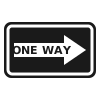
A traffic island in the middle of the road has this sign on it. Which way must you pass the island?
A A. Pass on its right sideB B. Pass on whichever side is clearerC C. Pass on its left sideD D. Drive over it if it is low and flat
Question 16 of 30 Signs and markings
You are on a road marked with this sign and want to turn right at the next corner. Where should your car be as you turn?
A A. As near as you can to the far right sideB B. Just to the left of the centre of the roadC C. Near the left kerb, then swing acrossD D. In any part of the road, if you signal
Question 17 of 30 Signs and markings
At an intersection with traffic lights, you see this sign. You want to turn around and go back. What applies?
A A. You must not U-turn at any traffic lightsB B. You may U-turn, and others must wait for youC C. You may U-turn here, giving way to everyoneD D. You may U-turn only while your light is red
Question 18 of 30 Safe driving
In South Australia, you have a crash where no one is hurt, but repairs to the other driver's car will cost well over $3000. When must the crash be reported to police?
A A. As soon as possible, and no later than 48 hoursB B. As soon as possible, and no later than 72 hoursC C. As soon as possible, and no later than 24 hoursD D. As soon as possible, and no later than 7 days
Question 19 of 30 Alcohol, drugs and penalties
Research has looked at how a driver's BAC affects the risk of a crash in which someone is hurt. What happens to that risk for each rise of 0.05 above zero?
A A. It rises by 5%B B. It rises by a quarterC C. It stays the sameD D. It doubles
Question 20 of 30 Hazards and sharing the road
You turn off the bitumen onto a long gravel road. How should you change your driving?
A A. Keep the same speed, as gravel has good gripB B. Speed up, since there is less traffic out thereC C. Slow down, as braking and control are harderD D. Brake hard on each bend to stop the car sliding
Question 21 of 30 Safe driving
After a crash, you swap details with the other driver. Which details should you give them?
A A. Only your mobile phone number so they can ring you about it laterB B. Only the name of your insurance company and your policy numberC C. Name and address of the driver and owner, plus the registration numberD D. Your date of birth and licence number, but never your home address details
Question 22 of 30 Safe driving
Your child has a medical condition and cannot use an approved child restraint. What allows the child to travel in a non-approved restraint?
A A. You have the car inspected by a mechanic firstB B. You carry a medical certificate for the childC C. You keep your speed to 70 km/h or lessD D. You get a letter from the car's maker
Question 23 of 30 Hazards and sharing the road
An ambulance with its siren on is coming up behind you. What must you do?
A A. Keep driving at the same speed in your laneB B. Move out of its path to give it a clear wayC C. Speed up so you stay well ahead of itD D. Stop at once, wherever you are in the lane
Question 24 of 30 Signs and markings
You stop where this sign applies to drop off a parcel at a door 10 metres away. May you leave the car to do this?
A A. Yes, if you are back within 5 minutesB B. Yes, as dropping off goods is allowedC C. No, you must stay within 3 metres of the carD D. Yes, if you leave the hazard lights on
Question 25 of 30 Safe driving
You are waiting to turn out of a side street onto a busy road. The driver behind you keeps sounding their horn. What should you do?
A A. Take the next small gap to keep things movingB B. Wait for a larger gap in the trafficC C. Wave the driver behind to go around your carD D. Edge out into the road to force a gap to open
Question 26 of 30 Hazards and sharing the road
You are in the left lane of a road in a built-up area. A bus at the kerb ahead has a 'Give way to buses' sign and is signalling to pull out. What must you do?
A A. Speed up and pass before it moves outB B. Sound your horn and keep on drivingC C. Keep going, as the bus must wait for a gapD D. Give way and let the bus pull out
Question 27 of 30 Signs and markings
Your passenger asks you to pull over for a moment where this sign applies, so they can hop out. What should you do?
A A. Stop for less than a minute to let them outB B. Stop, as long as you stay in the driver's seatC C. Stop, as long as your hazard lights are onD D. Drive on to a place where stopping is allowed
Question 28 of 30 Signs and markings
This sign is fixed to a barrier that blocks part of the road ahead where the road shifts across. Which way should you go?
A A. To the right, away from the chevronsB B. Either side, whichever looks clearerC C. Stop, as the road is fully closed aheadD D. To the left, the way the chevrons point
Question 29 of 30 Learner and P-plate rules
You are 27 and have just got your P1 licence in South Australia. Can you drive home from a late shift at 1 am on your own?
A A. Yes, the late-night limit is only for P1 drivers under 25B B. No, the late-night limit applies to every P1 driverC C. No, not until you have held your P1 for eight monthsD D. Only if you are driving straight home from work
Question 30 of 30 Signs and markings
On a country road, you pass a warning sign for stock, such as cattle or sheep. What should you expect on the road ahead?
A A. Stock trucks that must stop and give way to youB B. A stock yard where you may park on the roadC C. A stretch where only farm vehicles may driveD D. Farm animals crossing or walking beside the road
Answer each question to see the explanation. Keyboard: A–D or 1–4 to answer, N next, P previous.